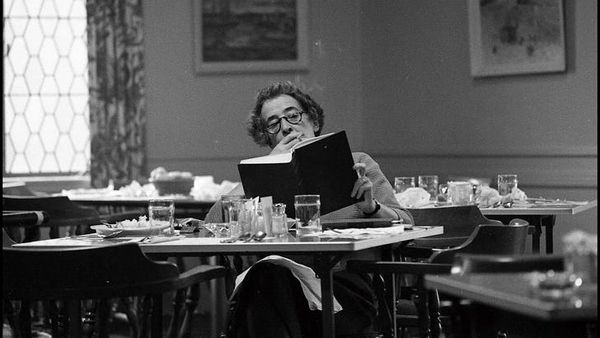
Authoritarianism Begins With Thoughtlessness: Hannah Arendt and the Physics of the Mind
What Hannah Arendt Can Teach Us Now: A Draw to Judgment Series
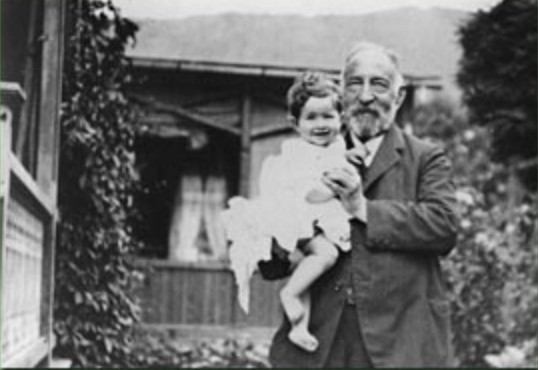
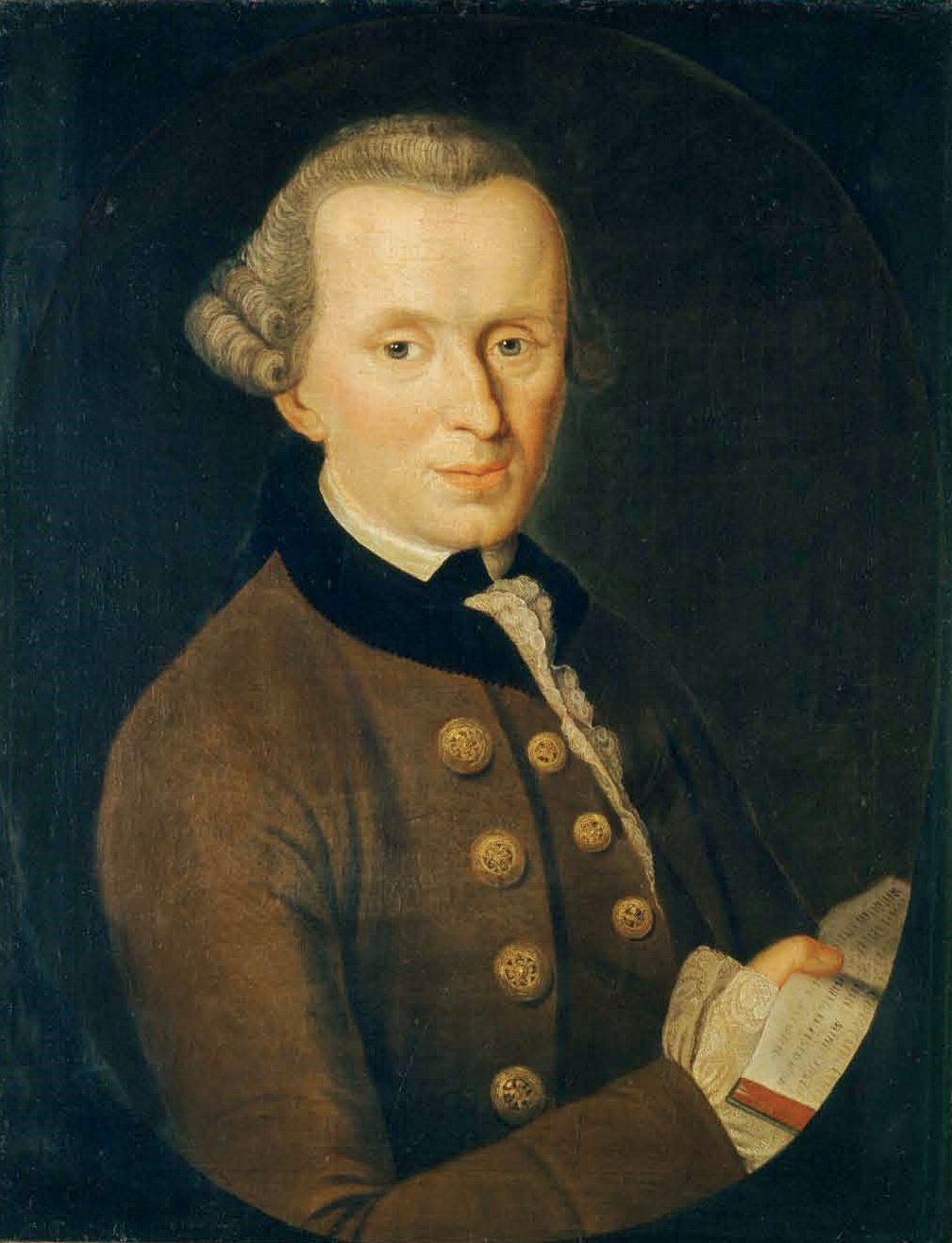
Before the Nazi period, German-speaking regions of Europe were often referred to as the land of “Dichter und Denker”—poets and thinkers. Hannah Arendt, born in 1906, was steeped in this tradition. Having mastered classical Greek and Latin by age 14, audited university lectures at age 16—she could unfortunately not matriculate until age 18—and finished her dissertation in philosophy at age 23, her young life exemplified this connection to the German culture of arts and letters. She was not just a philosopher, but an avid poet herself.
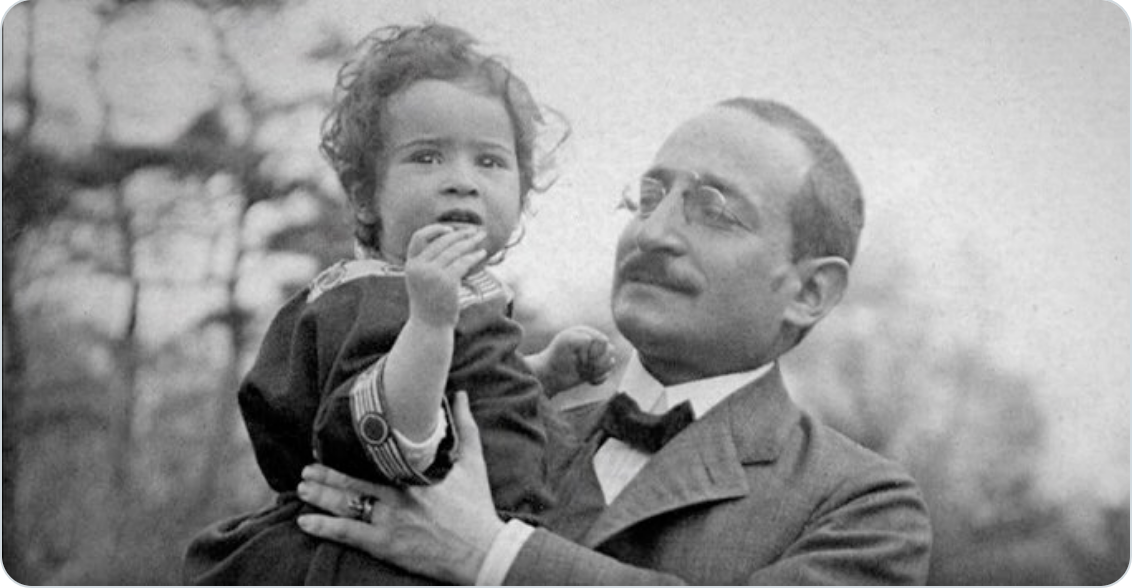


This is what it meant to be of German culture in the early 20th century: a strong identification and participation with the artistic process and its final products. It was open to everyone. It didn’t matter who you were and what you earned, even the less formally educated and less intellectually-inclined had Goethe’s and Schiller’s works displayed proudly in their living rooms.

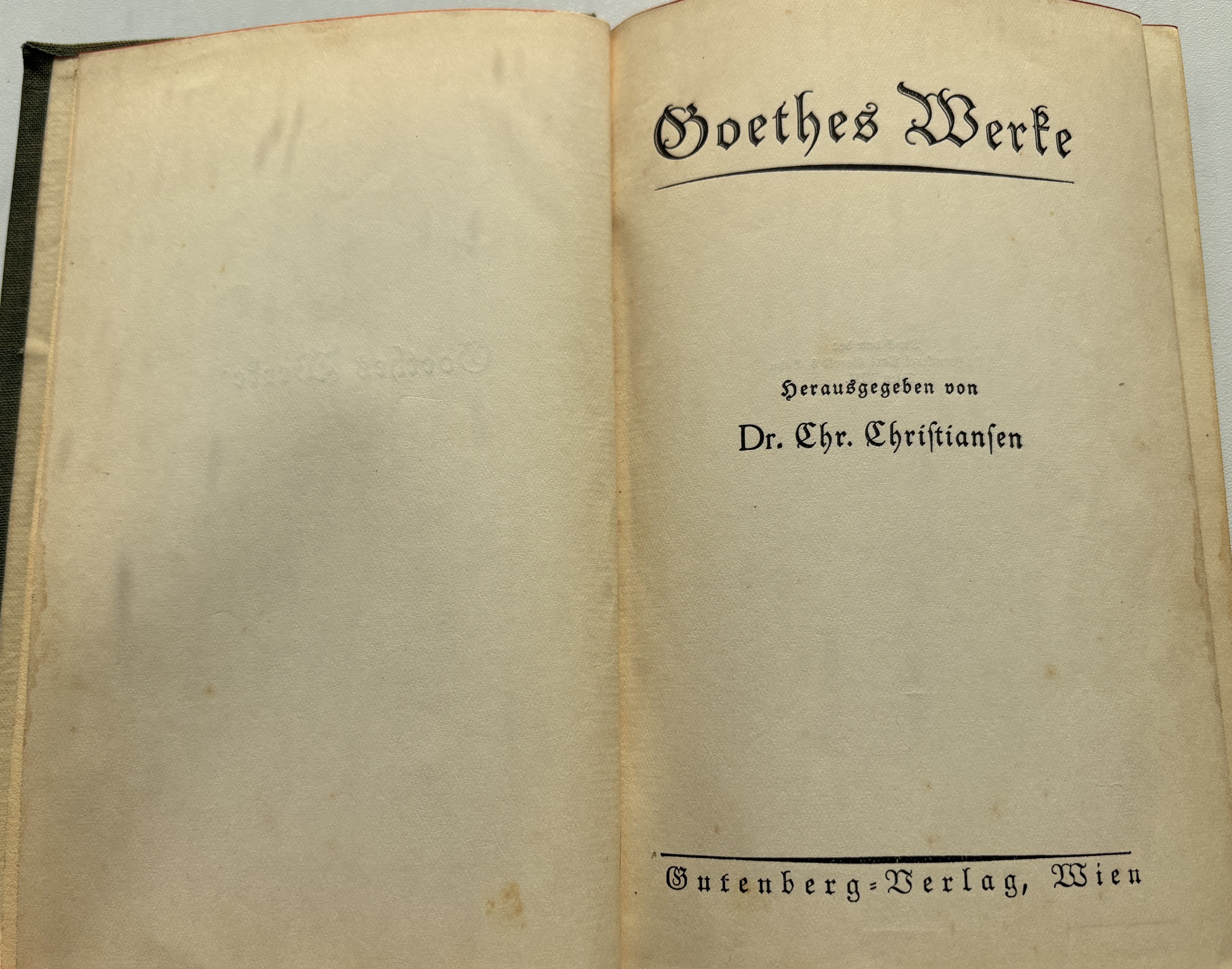
How did this great civilization of artists and intellectuals descend into genocide, mass murder, and self-destruction? As a refugee in the 1940s, this was Hannah Arendt’s obsession. The Origins of Totalitarianism, published in 1951, was her first answer. She not only provided a political theory for the rise of totalitarianism; she carefully documented the empirical conditions that led to its rise. In the late 1960s, she moved from politics to the study of thought. The idea was to understand how an inability to engage in critical thinking was the true origin of evil, not an inherent diabolical nature or intention.
How did Goethe become Goebbels and Bach become Bergen-Belsen?
Arendt’s answer: After the dislocations of the Great War and its immediate aftermath, the Spanish flu pandemic of 1918, and the enormous reparations demanded from Germany and Austria in the Treaty of Versailles, fear and loathing—the entry point for narcissistic behavior—replaced a sense of higher calling that permeated much of German-speaking cultures for hundreds of years.
Does this sequence of events sound familiar?
For Arendt, fear and loathing are the external signs of “thoughtlessness,” a state in which thought and agency are outsourced to an external actor for the sake of stability and consistency: “[The modern masses] do not believe in anything visible, in the reality of their own experience; they do not trust their eyes and ears but only their imaginations … What convinces masses are not facts, and not even invented facts, but only the consistency of the system of which they are presumably part.”1
But what exactly is “thoughtlessness”? And what, for that matter, is “thought” itself? In my last essay, “No “Soul’? The Euphoria That Built Hannah Arendt’s Philosophy of the Mind,” I started to explain how Arendt connects time to the mind as the ontological basis of its different aspects. “Thinking,” unlimited in direction and outcome, stands outside of time. “Cognition,” confirmation of the familiar to make decisions, links the past as present to the future. “Willing” is entirely future-oriented. It answers the question “what is my end goal”?
My last discussion ended with this highly abstract description of Arendt’s philosophical achievement: “The mind of Arendt is not an array of ‘rooms,’ but rather is a time-space relationship poetically fusing classical physics with a popularized understanding of Einstein’s theory of General Relativity.” Today, I want to make this description concrete. Many English language idioms contain a time element. These idioms reveal by their very construction the ontological relationship of time to the mind.
Let’s start with thinking: Consider first the phrase “lost in thought.” To daydream means not noticing the passage of time. Have you ever gotten sidetracked while reading a book or trying to solve a problem? Maybe you ended up late for an important meeting or an event you were looking forward to? Lost track of time in thought, didn’t you?
A brief word from this essay’s “sponsor.” We recognize the experience of not noticing the passage of time after finishing a thoughtful piece— that like or share doesn’t happen. However, Substack now promotes writers largely through restacks. If you value this work, we’d be grateful if you restacked it — even if you haven’t fully decided what you think about it. A restack isn’t an endorsement of a conclusion. It’s a vote for the conversation Arendt valued.
Contrast the thought-experience with cognition. Have you ever wanted to reassure yourself of a decision or the best course of action? Is time suspended for you in these moments? Maybe you feel stuck in the present and don’t trust the past? Indeed, is the time-based definition of anxiety a consistent loop of the future back to a pastless-present that serves only to create inaction?
Now let’s consider willing, a far more future-oriented process that relies on ideal or imagined outcomes. Do we interrogate a problem carefully? Or do we chastise ourselves for “rushing into a decision” without considering the in-between steps? Conversely, what do we tell ourselves when we say “the end justifies the means”? Does this statement rationalize destructive behavior for the sake of an imagined perfect moment?
This is the graphic Arendt used in The Life of the Mind to illustrate these time relationships.
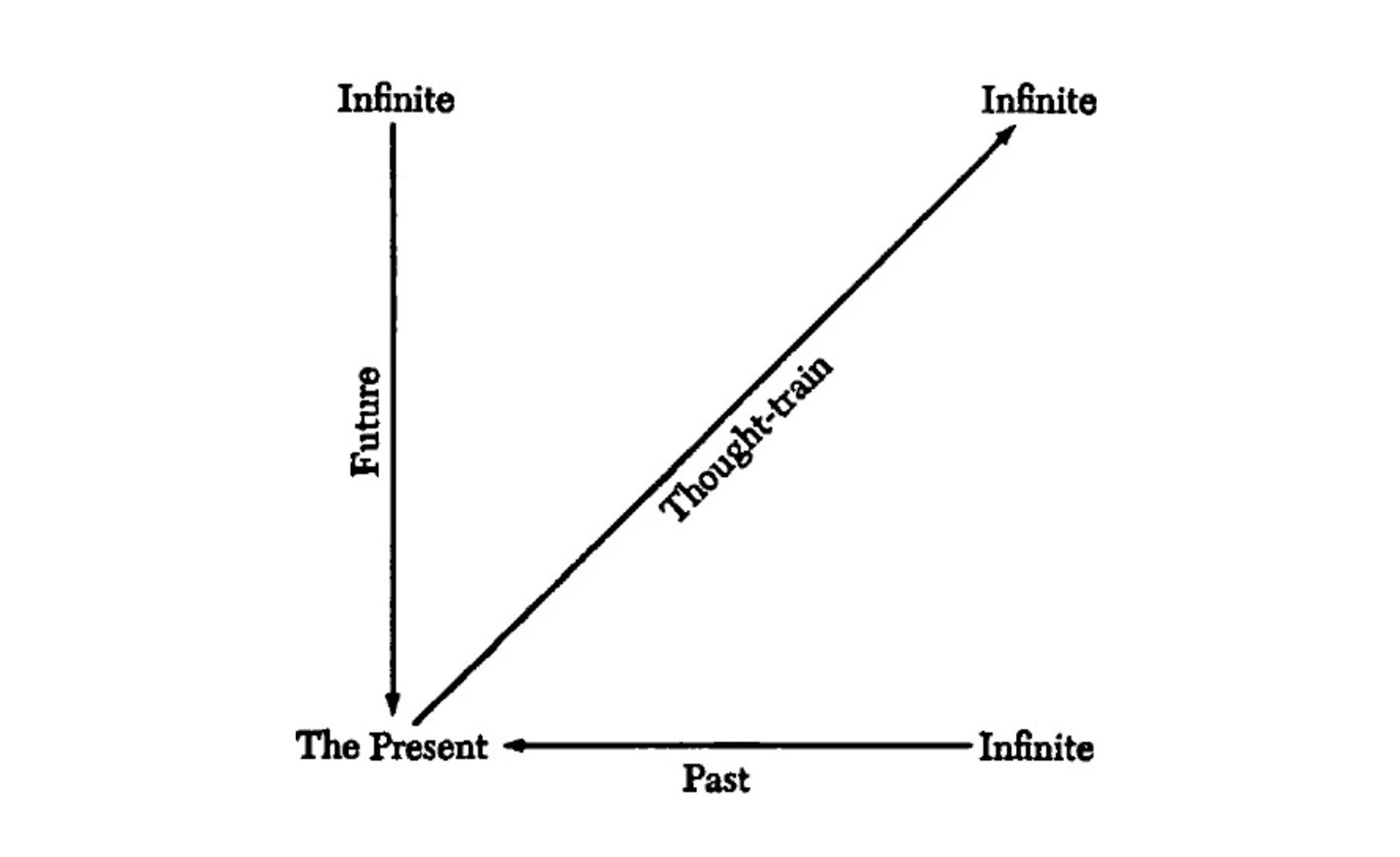
As noted in my last piece, Arendt had some training in classical physics in the 1920s. Given the rapid developments in relativity and quantum mechanics, she likely did not have access to a physics-for-poets shorthand of developments in these fields. Given how she describes the relationship between thinking and willing, however, perhaps a physics update is in order. Newton was born during a time of political upheaval: the beheading of Charles I and the rise of Oliver Cromwell. This situation heavily influenced how he constructed his physics. In the late 17th century, European monarchy is intimately associated with the divine right of kings. It makes sense that Newton would have posited time as separate from the mechanical world. Presenting time as a dimension would have shaken the link between sovereign and the infinite (Unlike Newton, Descartes and Leibniz were freer to explore time as variable rather than as a constant).2
From 1776 on, however, government in political theory and practice became slowly detached from a strict, hierarchical social order, making it far easier to posit time as a coequal dimension with space. Given Arendt’s focus on time as an essential element of the human condition in her later work, I think her visual deserves an upgrade. Rather than using the two-dimensional XY axis to illustrate the “timelessness” of the mind in motion, perhaps the tesseract is a more useful illustration.
A tesseract is a rendering of nesting space-time coordinates that link over distance and sometimes collapse on themselves. In Einstein’s General Relativity, these dimensions are not static; they can be folded and warped, like an origami project. Rather than each point of the cube remaining at linear distances from each other, the object morphs and collapses on itself so that different points in space and time can exist simultaneously. The video below gives a basic sense of the four dimensions, how the multilayered cube morphs into new configurations of time and space.
This second video illustrates far better the wide-ranging probabilities contained within the space-time continuum. Arendt’s unfinished work in The Life of the Mind pointed to the enormous variation in the overlap of different mind aspects.
How can we make the probabilities of the tesseract more concrete? Let’s consider Post Traumatic Stress Disorder, where the past makes itself known repeatedly in the present. It is an uninvited guest, often at strange and inopportune moments. These past manifestations carry all sorts of complex connections that don’t necessarily make sense to the outside observer, but make perfect sense to the sufferer.
In the popular 1993 film Groundhog Day,3 Bill Murray’s character, Phil Connors, is an excellent example of how a person experiences a time-loop from trauma—in this case, being asked to be someone he is not. To both compensate for and place himself above these demands, he fulfills his hedonistic desires over and over again without meaning. Put in Arendtian terms, Connor’s willing occurs without thought. His lack of inhibition creates its own time loop where the future collapses into the past in a seemingly endless cycle to realize itself. There is no transcendence, just action without meaning. Connors is only able to escape the time loop when he begins to realize that he has outsourced his person in narcissistic fashion to an environment that doesn’t fit him. He is able to move forward precisely when he chooses not better personal and professional company, but more resonant personal and professional company.
This fraught situation of will without thought is exactly what Arendt is pointing to when she quotes Epictetus, a Greek Stoic philosopher of the 2nd century CE, to illustrate and emphasize the dangers of volition in her section on “Willing”:
Epictetus makes it clear that volition can outrun reality, exactly the scenario in Groundhog Day. Arendt takes this point even further and applies it to the ontology of thought. The will and self-satisfaction are one and the same. They disrupt clear thinking. The way to avoid this problem per Epictetus is to pay attention to the empirical—“events should happen as they do.” In other words, Epictetus establishes a concrete reference point, exactly what Phil Connors eventually encounters in his romantic interest, Rita, who shows that smart and ethical are not mutually exclusive.
Unfortunately, the outsourcing of a human being’s personality is rarely resolved as entertainingly as it is in a Hollywood movie. It has great potential, on the contrary, to lead to reckless behavior and political choices that generate authoritarianism and totalitarianism. When individuals so severely suppress their ability to think and act critically, when they outsource themselves, they actively destroy their sense of self and personality signature. After the Holocaust and the Second World War, German speakers found it difficult to think for themselves. Ernest Jouhy observed in Commentary magazine in 1960: “Clearly, the majority of Germans would accept an authoritarian government if it seemed likely to preserve them from a totalitarian one. And they might even prefer an authoritarian government to a genuinely democratic one, for its political technicians would relieve them of active participation in public affairs, and above all, of responsibility.”5 Likewise, Hannah Arendt wrote in Origins ten years earlier:
The members of totalitarian movements, utterly fanatical as long as the movement exists, will not follow the example of religious fanatics and die the death of martyrs (even though they were only too willing to die the death of robots). Rather they will quietly give up the movement as a bad bet and look around for another promising fiction or wait until the former fiction regains enough strength to establish another mass movement. [363]
This suggests that for party members, sympathizers, and accomplices, they did not return to a thinking state of individual being, but rather remained hollowed-out shells, essentially inanimate objects—like asteroids or comets—whose trajectory in time or space relies on complete control by an external gravity. This is the “thoughtlessness” Arendt saw in Adolf Eichmann during his 1961 trial in Jerusalem.
In an August 2025 interview with me, clinical psychologist Dr. Simon Rogoff put his finger on the chilling essence of subsuming one’s thoughts under someone else’s: “There’s an idea that what’s offered [in narcissistic relationship] … in place of reality is a kind of seduction. ‘I can offer you what you’re looking for, but you’ll sacrifice reality and truth in the process.’” Next time, I will begin to explore how The Life of the Mind addresses what this loss of self-concept means for human behavior. In the meantime, consider how the relinquishment of thought to the state is portrayed in this five-minute clip from Leni Riefenstahls’ 1935 film Triumph of the Will (Triumph des Willens). At timestamp 3:35 forward, Hitler’s followers enter the picture. Do they exhibit individual thought and will?
Hannah Arendt, The Origins of Totalitarianism (San Diego: Harcourt Brace Jovanovich) 351. ↩
Carl Hoefer, Nick Huggett, and James Read, "Absolute and Relational Space and Motion: Classical Theories," Stanford Encyclopedia of Philosophy, first published July 19, 2021, https://plato.stanford.edu/entries/spacetime-theories-classical/. ↩
Surprised at this reference? ↩
Epictetus, Discourses, quoted in Hannah Arendt, The Life of the Mind, vol. 2, Willing (New York: Harcourt Brace Jovanovich, 1978), 338. ↩
Ernest Jouhy, “German Youth and German History,” Commentary, April 1960, https://www.commentary.org/articles/ernest-jouhy/german-youth-and-german-history/, accessed March 23, 2026. ↩