Who Gets to Govern? The Collapse of Perception—from Immanuel Kant to the White House
What Hannah Arendt Can Teach Us Now: A Draw to Judgment Series
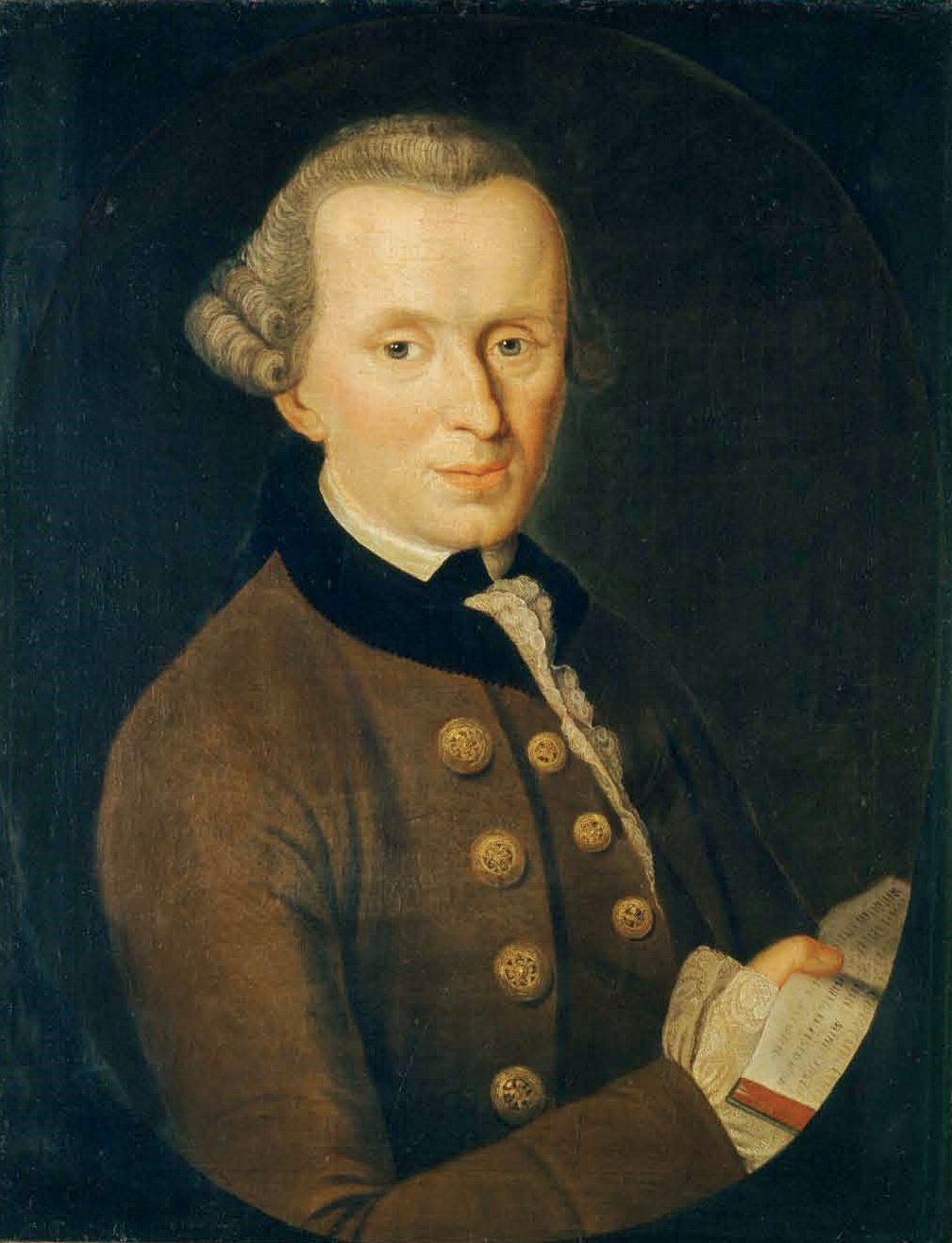
Between 1770 and 1787, in the decades leading up to the French Revolution, Immanuel Kant revised his work, The Critique of Pure Reason over and over again.1 He was responding to and synthesizing two symbiotic intellectual currents of the eighteenth century: 1) the rise of Newtonian physics, which placed a premium on a mechanistic understanding of the world, and 2) the questioning of divinely-ordained state and religious authority that kept the governance of human affairs outside of most men’s capabilities. At the heart of these concerns was the ability of men—at the time it was almost exclusively men—to know and govern the world. Did this knowledge and the ability to act accordingly require celestial access and intervention? Or could man’s reasoning ability alone do the job just as well?
In this Substack column, one that has devoted itself so far to Hannah Arendt’s materialist project of halting totalitarian drift, why suddenly introduce a 250-year-old work of metaphysics? The answer has to do with how the United States and the world are experiencing an authoritarian White House. As the second Trump presidency has moved from unethical and chaotic to repugnant and degrading, many inside and outside of the United States have been brought to ask larger moral questions about politics and government—veering sharply away from the usual play-by-play of political coverage and analysis.
For about ten years now, the USA and the world have struggled to respond to Donald Trump. Some pegged him from the outset as a fascist personality who would first bring about chaos, then harness the public’s desire for stability and safety into proto-fascist moves designed to aggrandize power. Others, like many in the press, saw a clown who deserved public mockery, but overlooked that his buffoonery would become a rebellious point of identification for his supporters, rather than a springboard for dismissal. And, of course, there were plenty with money and power who wanted to capitalize personally on this new turn in politics or at least ensure profit in a moment of great political transition—much like the exchange of money and politics in fascist Europe 80 years earlier. These un-unified and somewhat superficial responses to Trump hindered an effective resistance. In particular, a lack of understanding about the origins and dynamics of Trump’s personal and political strategies meant that even his strongest opponents often played into or even mimicked his authoritarian behavior.2 It took the murder of two innocent American citizens this year and many constitutional violations for a far greater number of people to witness his malignant narcissism, as well as the sycophants who enabled him.
The inability to understand the origins and meaning of Trump’s behavior is what has made it difficult to communicate well the dangers of his presidency—even from the resistance itself. Poor strategies in this existential battle often come from a focus on facts and counterfacts. However, the true difficulties in combating Trump have far more to do with perception and interpretation—issues that Kant raised 250 years ago in his Critique of Pure Reason. As Hannah Arendt wisely observed in The Origins of Totalitarianism, “[w]hat convinces masses are not facts, and not even invented facts, but only the consistency of the system of which they are presumably part.”3
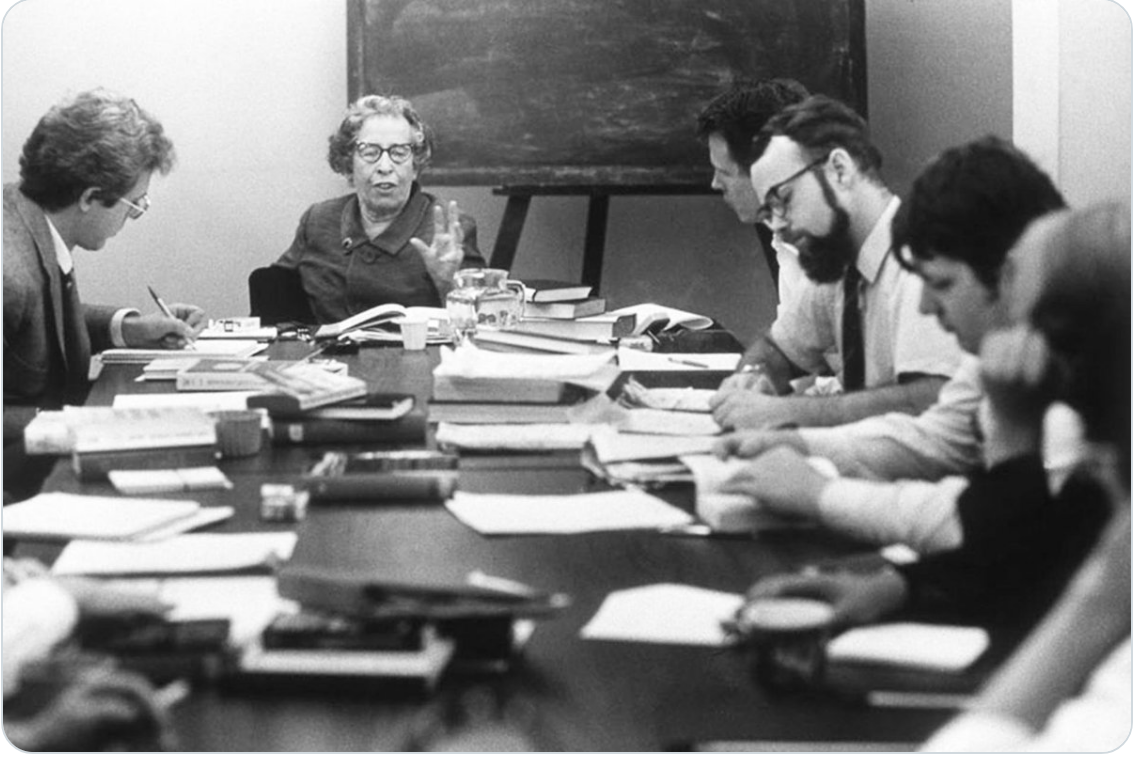
Totalitarian political disintegration, in other words, should be understood as far more than an empirically observable checklist of signs and symptoms. It is rather a collapse in perception—a loss of ability to think and judge. This was precisely the problem that Kant tried to address in his work Critique of Pure Reason, a timeless exploration of mental processes—processes that escape the demands for tangible evidence, scientific study, and replication after the Age of Enlightenment. Two hundred years later, Hannah Arendt re-examined his arguments in her work The Life of the Mind. She sought to move beyond the Enlightenment’s faith in reason and rationality to demonstrate precisely how the mind itself makes authoritarian conditions possible. Her primary question: To what extent does the ability to think well, poorly or not at all create good or poor conditions for self-governance?
This change in focus was a significant move for Arendt. She made her name in the 1950s with empirical political theory. In the early 1970s, however, she pivoted to pure metaphysics after a number of transitional publications. What brought this new direction? To understand this professional development, we need to go back to 1963, when her reporting on the trial of Adolf Eichmann appeared in The New Yorker. It eventually was published in book form as Eichmann in Jerusalem: The Banality of Evil (Eichmann was one of the principal architects of the Holocaust, responsible for developing the logistics of the extermination of six million European Jews).
Arendt, a German-Jew herself, likely pursued the assignment out of curiosity. She herself fled Germany in 1933 after the Gestapo arrested her for researching antisemitic propaganda. What she could not anticipate, however, was her visceral response to finally seeing Eichmann on the witness stand. During the trial, she frequently felt physically ill and exhausted. Like many others, she laughed out loud during Eichmann’s testimony—a response that understandably can seem tone-deaf and confusing for those who have not experienced this level of trauma. While this sort of laughter is recognized today as a well-documented trauma response, this framework was simply not available sixty years ago to explain and contextualize her reactions.4 On the contrary, for most of her life—and frankly, for just about everyone else at the time—a “faulty” reasoning process, not the rupture of trauma, was the primary explanatory framework for these reactions. As she wrote her reportage and analysis for The New Yorker, she nevertheless used her philosophical training to manage this intense emotional response. The end result was a brilliant and unusual portrayal of the trial that transformed her unanticipated personal reaction to Eichmann’s self-presentation and speech into intellectual rocket fuel.
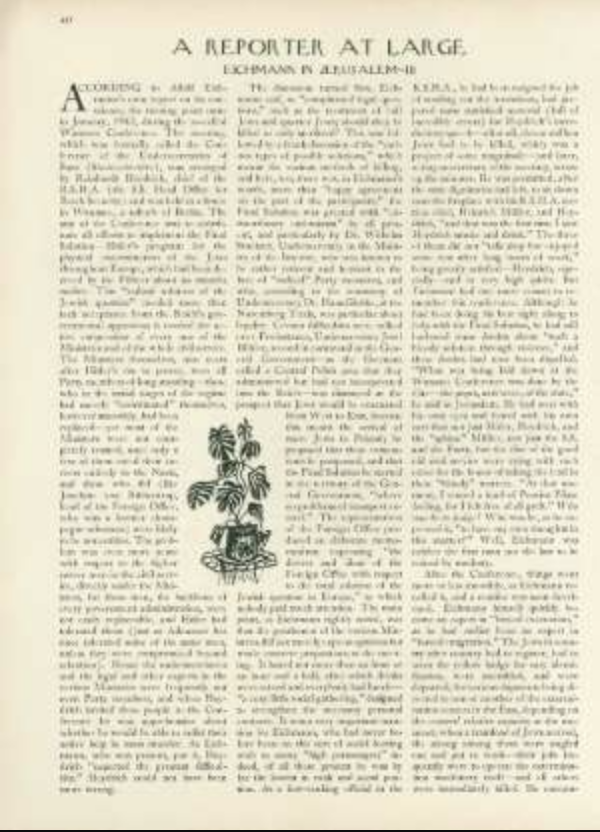
The main point Arendt wanted to convey in her New Yorker series was that Eichmann’s appearance and comportment defied expectations. He was not the classic melodramatic villain that everyone wanted him to be: extra-human, charismatic, and unapologetic—certainly not a conspicuous and overpowering maleficent presence.5 Instead, this perpetrator of industrialized mass murder stammered and was unable to weave a consistent narrative. Arendt describes how, on the one hand, he denied responsibility: “With the killing of Jews I had nothing to do. I never killed a Jew, or a non-Jew, for that matter —I never killed any human being. I never gave an order to kill either a Jew or a non-Jew; I just did not do it.”6 Yet, his testimony also placed himself in the heart of operations when he remembered a conversation with an SS officer: “[I]t is horrible what is being done around here; I said young people are being made into sadists. How can one do that? Simply bang away at women and children? That is impossible. Our people will go mad or become insane, our own people.”7
The evasiveness and imprecision of Eichmann’s speech led Arendt to conclude that evil was the product of “thoughtlessness”—an inability to ask tough questions about oneself and one’s surroundings. Revisiting the trial in her introduction to The Life of the Mind—her professional and financial situation secure by the early 1970s—Arendt wrote:
“Evil, we have learned, is something demonic; its incarnation is Satan … However, what I confronted with was utterly different and still undeniably factual. I was struck by a manifest shallowness in the doer that made it impossible to trace the uncontestable evil of his deeds to any deeper level of roots or motives. The deeds were monstrous, but the doer—at least the very effective one now on trial—was quite ordinary, commonplace, and neither demonic nor monstrous. There was no sign in him of firm ideological convictions or of specific evil motives, and the only notable characteristic one could detect in his past behavior as well as in his behavior during the trial and throughout the pre-trial police examination was something entirely negative: it was not stupidity but thoughtlessness … Cliches, stock phrases, adherence to conventional, standardized codes of expression and conduct have the socially recognized function of protecting us against reality … .”
In today’s psychotherapy vocabulary, we use words like “compartmentalization,” “fragmentation,” “splitting” or “parts at odds with each other” to describe how the mind conceals from itself things that need to be revealed and witnessed. In my next essay on this last work, I will begin to discuss in more detail how Arendt uses metaphysics and phenomenology to examine human behavior through the mental capacities of “thinking” and “willing” and why these capacities are important for understanding the human potential for good and evil.
In the meantime, I’d like my readers to apply Arendt’s concept of “thoughtlessness” to contemporary politics. On February 24, 2026, Donald Trump delivered the State of the Union address in a lengthy two-hour speech. Below is a YouTube video of the event with of and providing commentary in the style of Mystery Science Theater 3000—something that makes the experience infinitely more bearable, in my humble opinion. Watch as much of it as you can stand and answer the following questions: 1) How are Trump’s patterns of speech just as “thoughtless” as the Eichmann examples above, no matter the very different contexts? 2) What could those in attendance, particularly those receiving recognition from Trump, have done to maintain decorum while maintaining emotional and professional distance?
Immanuel Kant, Critique of Pure Reason, ed. and trans. Paul Guyer and Allen W. Wood, The Cambridge Edition of the Works of Immanuel Kant (Cambridge: Cambridge University Press, 1998). The Cambridge Edition of the Critique of Pure Reason is the definitive modern scholarly text due to its strict terminological consistency and literal translation style. It provides a comprehensive view of the work's two-decade evolution by presenting the significant revisions between the 1781 and 1787 editions alongside Kant’s own handwritten marginal notes. This transparency allows readers to trace the internal tensions and structural shifts in Kant’s attempt to define the limits of human cognition and governance. Philosophers, it is important to note, may shift perspective over the course of a lifetime. ↩
See R. T. Greenwald, “Arendt, Iran, and the Seduction of Certainty: Ceci n’est pas un président--Conversation 2.1,” The Draw to Judgment (Substack), July 11, 2025. ↩
Hannah Arendt, The Origins of Totalitarianism (London: Penguin Classics, 2017), 461, Apple Books edition. ↩
For Arendt’s physical symptoms, see Elisabeth Young-Bruehl, Hannah Arendt: For Love of the World (Yale University Press, 1982), 329–335. Arendt discusses how she laughed as she reviewed evidence in her 1964 interview with Günter Gauss: Hannah Arendt, "Was bleibt? Es bleibt die Muttersprache," interview by Günter Gaus, Zur Person, ZDF, October 28, 1964, approx. 49:00-50:00. On the psychological phenomenon of nervous laughter as a regulatory response to overwhelming stress or trauma, see Oriana R. Aragón et al., “Dimorphous Expressions of Positive Emotion: Displays of Both Care and Aggression in Response to Highly Positive Stimuli,” Psychological Science 26, no. 3 (2015): 259–73; see also Stanley Milgram, “Behavioral Study of Obedience,” Journal of Abnormal and Social Psychology 67, no. 4 (1963): 371–378. ↩
Hannah Arendt, The Life of the Mind, ed. Mary McCarthy (New York: Harcourt, 1978), 12, Kindle edition. ↩
Hannah Arendt, Eichmann in Jerusalem: A Report on the Banality of Evil (New York: Penguin Classics, 2006), 97, Apple Books edition. ↩
Ibid., 244. ↩