Arendt, Iran, and the Seduction of Certainty: Ceci n’est pas un président--Conversation 2.1
What Hannah Arendt Can Teach Us Now: An Elephant in the Room Series

© R.T. Greenwald, 2025. The ideas, arguments, and original frameworks presented here are the intellectual property of the author and require formal citation when referenced or adapted. For permissions, collaborations, or inquiries about appropriate use, please send me a DM.
Today’s conversation begins to relate Hannah Arendt's discussion of antisemitism in The Origins of Totalitarianism to her understanding of the social and political forces underlying totalitarian dynamics and structures. As we move forward, keep our discussion of Arendt’s understanding of antisemitism in mind, including her critiques of Jewish behavior in the face of this changing political conditions. I won’t be discussing antisemitism specifically today, but it plays an important role in shaping a political structure that promises belonging and safety through exclusion. In this way, Arendt’s discussion of antisemitism lays the groundwork for her broader analysis of how identity, ideology, and mass behavior function in modern political systems.
Arendt titles the second and third sections of Origins “Imperialism” and “Totalitarianism.” She seems at first to emphasize political systems and actions, but the heart of her analysis is psychological and sociological. Her interest is in belonging and safety as political identities shift. Unlike Marxist-Leninist theories that root imperialism in the late stages of capitalism, Arendt’s interest in the subject has more to do with changing understandings of belonging in the body politic. Class and capital play a role in her work, but Arendt isn’t writing from the perspective of dialectical eschatology—thesis-antithesis-synthesis headed toward the end of history. Instead, her political theories explore mass human psychology under duress, especially how alliances shift when the sense of threat can’t be neutralized.
Imperialism, according to Arendt, provided a pre-authoritarian escape mechanism for European countries that had amassed great territories. When employment was scarce at home, men were given grand personal visions, which dovetailed with exceptional national missions that were realized abroad. These missions relied heavily on fin-de-siècle beliefs in Western superiority, which were used to rationalize violent methods and outcomes. Arendt suggests that these violent methods and outcomes were both a buffer for and a projection of domestic instability, keeping the scapegoat for the ills of the nation-state geographically distant from the heart of imperial power centers like Britain and France. Where no large-scale, contemporary imperialist project developed—Germany and Russia—the scapegoat was invented at home with fabrications such as the antisemitic Protocols of the Elders of Zion. Under these conditions, violence turned inward: “The revolt of the masses against ‘realism,’ common sense, and all ‘the plausibilities of the world’ (Burke) was the result of their atomization, of their loss of social status along with which they lost the whole sector of communal relationships in whose framework common sense makes sense” (461).
There are many domestic and political currents to unpack in Arendt's analysis, certainly more than I can address in this brief conversation. I will be coming back to this topic in the future. Today, I’d like to focus on how political consolidation, in Arendt’s observations, is developed in propaganda and prophecy during times of upheaval.
In Arendt’s analysis, propaganda serves as the public face of ideological control—it manipulates facts, simplifies narratives, and encourages citizens to adopt rigid, us-versus-them worldviews. It is designed for persuasion, particularly in the early stages of mass mobilization. But once a totalitarian regime consolidates power, propaganda is often replaced by what Arendt calls prophecy. Prophecy, in this context, is not religious or metaphorical, although its effect is intended to produce a sense of awe; it is the regime's practice of making political predictions about enemies or outcomes, and then using state power to make those predictions come true.
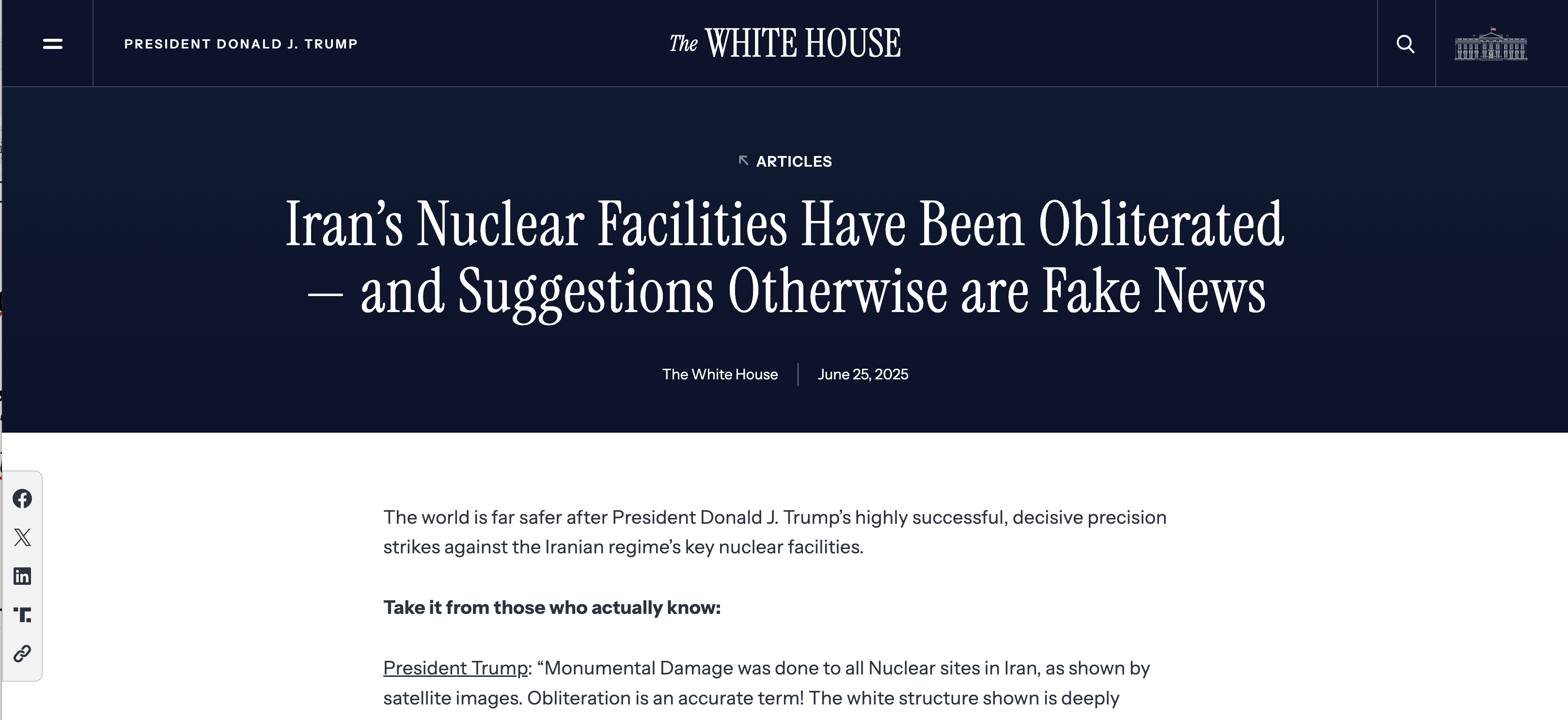
A promising avenue for relating Arendt’s understanding of propaganda and prophecy to contemporary events can be found in the recent commentary surrounding Trump’s bombing of Iranian nuclear facilities on June 21, 2025—commentary that was published too early to have an empirical basis. Particularly important is the creation of certainty on both sides of the argument—certainty of success, stability, and safety for the White House, as well as certainty of failure, instability, and danger for the opposition. Let’s start with this June 25, 2025 White House press release, just four days after the bombing. How does it express certainty of success, stability, and safety, according to Arendt’s framework?
And here are two prominent opposition reactions published on Substack. How do they express certainty of failure, instability, and danger?
‘America is at War in the Middle East. Again.’ — June 22, 2025
‘We throw around words like ‘normalization’ and ‘numb’ too often ... By attacking Iran without any congressional input Trump blatantly ignored both the Constitution and the War Powers Act. And the reaction (even among some Never Trumpers) is to simply shrug.’ — June 23, 2025
Let’s consider the White House statement first. Its press release is designed to instill confidence and sense of safety in the general population, but it is also worth noting that it has not yet reached the level of prophecy as Arendt defines it:
‘The propaganda effect of infallibility, the striking success of posing as a mere interpreting agent of predictable forces, has encouraged in totalitarian dictators the habit of announcing their political intentions in the form of prophecy’ (457).
‘The language of prophetic scientificality corresponded to the needs of masses who had lost their home in the world and now were prepared to be reintegrated into eternal, all-dominating forces which by themselves would bear man, the swimmer on the waves of adversity, to the shores of safety’ (459).
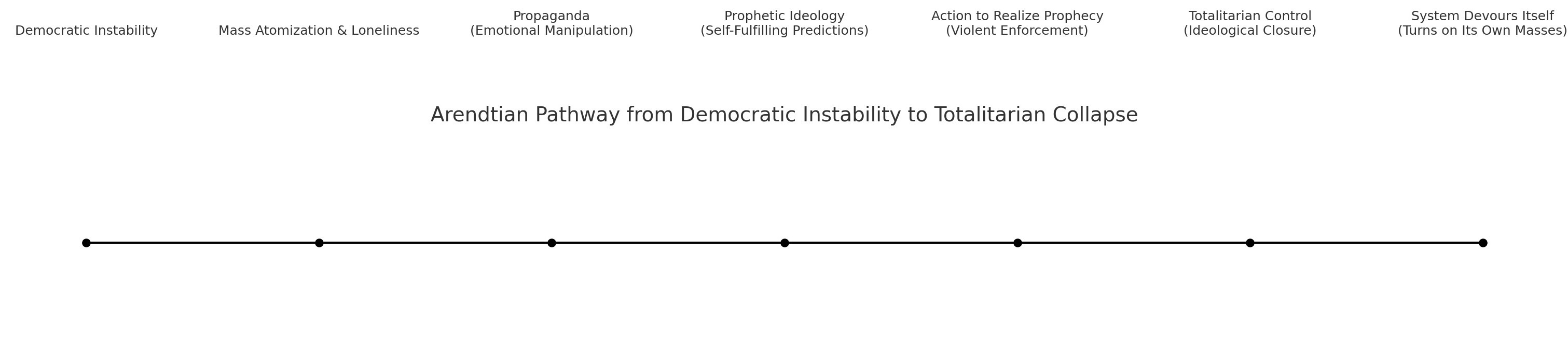
For Arendt, the purpose of prophecy in totalitarian regimes is to give the public consistent and regular assurance that everything is under control in a way that matches ideological predictions. The regime’s ideology, expressed in the fulfillment of prophetic action statements, creates tautological situations that demonstrate a government consistently realizing a master plan. This eschatology is grounded not in divine revelation or spiritual insight, but in man’s presumed knowledge of history and science.
Whether under National Socialism or Bolshevism, historical and scientific reality is created by political action that affirms preceding statements of intent. It is divorced from truth and instead becomes whatever the regime offers against the current enemy. The prophecy is affirmed when the regime completes action against the enemy and ostensibly restores safety, resulting in the growth of the general population’s faith and willingness to submit. Eventually, the regime devours the masses and eats itself.
Where does this leave the statement from the White House? It’s not prophecy. The White House statement does not announce political intentions. It is merely asserting, in somewhat insecure fashion (“fake news”), that the bombing has made the world definitively safer. The statement is an attempt to maintain authority in the face of some public doubt expressed immediately after the bombing. As such, its insecurity serves the opposite purpose of prophecy: undermining the power of the White House by confirming its lack of sovereign reliability.
At the same time, the opposition is attempting to create certainty through statements that can sound prophetic in their premature judgment. One announces that the US has entered into war again in the Middle East without evidence of future action requiring mass mobilization. The other treats executive branch action without Congressional approval as an indicator of authoritarianism, although previous administrations have acted independently without destroying American democracy. The opposition—completely out of power nationally—is asserting a truth without attention to future possibilities. By doing so, it is attempting at the time of writing to reclaim democratic sovereignty that it believes is lost, but isn’t necessarily. On the contrary, the lack of severe consequences for the opposition’s speech indicates no full authoritarian control at this point and certainly not a coalesced totalitarian system. At some point in the future, these political systems could become reality, but it is premature to declare this a fait accompli.
In summary, both leadership and opposition are expressing their will in somewhat magical terms. Their statements are designed to create certainty, but they don’t have the power to make their intentions a command.
Now it’s your turn.
What does it mean when leadership, whether in the White House or the press, engages—or even captivates—its audiences with uncertain statements of certainty? Here are some quotes from The Origins of Totalitarianism, followed by questions, to help you consider some of the phenomenology1 of totalitarianism that Arendt presents:
“[The Nazi movement] did not need to refute opposing arguments and consistently presented disagreements as invariably originating in deep natural, social, or psychological sources beyond the control of the individual and therefore beyond the power of reason” (408).
“Indifference to public affairs, neutrality on political issues, are in themselves no sufficient cause for the rise of totalitarian movements. The competitive and acquisitive society of the bourgeoisie had produced apathy and even hostility toward public life not only, and not even primarily, in the social strata which were exploited and excluded from active participation in the rule of the country, but first of all in its own class” (410).
“Totalitarian movements are possible wherever there are masses who for one reason or another have acquired the appetite for political organization. Masses are not held together by a consciousness of common interest and they lack that specific class articulateness which is expressed in determined, limited, and obtainable goals. The term masses applies only where we deal with people who either because of sheer numbers, or indifference, or a combination of both, cannot be integrated into any organization based on common interest, into political parties or municipal governments or professional organizations or trade unions” (407).
“The truth is that the masses grew out of the fragments of a highly atomized society whose competitive structure and concomitant loneliness of the individual had been held in check only through membership in a class. The chief characteristic of the mass man is not brutality and backwardness, but his isolation and lack of normal social relationships” (415).
“The assumption of infallibility, moreover, is based not so much on superior intelligence as on the correct interpretation of the essentially reliable forces in history or nature, forces which neither defeat nor ruin can prove wrong because they are bound to assert themselves in the long run. Mass leaders in power have one concern which overrules all utilitarian considerations: to make their predictions come true. The Nazis did not hesitate to use, at the end of the war, the concentrated force of their still intact organization to bring about as complete a destruction of Germany as possible, in order to make true their prediction that the German people would be ruined in case of defeat” (452).
- What do unverifiable statements of certainty accomplish for those with the power of enforcement?
- What do unverifiable statements of certainty accomplish for those with the power of persuasion?
- What role do these statements play in creating a sense of safety for their readers? Or a sense of danger?
- What kind of social and political dynamics do these statements produce when they are trusted, but not verified?
- Can Arendtian prophecy co-exist with freedom of speech?
Oxford English Dictionary, s.v. “phenomenology,” accessed July 10, 2025, https://www.oed.com/dictionary/phenomenology_n?tab=meaning_and_use ↩