Authoritarianism and Its Antidote: Arendt Meets Gandhi in the Age of Trumpian Narcissism
What Hannah Arendt Can Teach Us Now: An Elephant in the Room Series
© R. T. Greenwald, 2025. The ideas, arguments, and original frameworks presented here are the intellectual property of the author and require formal citation when referenced or adapted. For permissions, collaborations or inquiries about appropriate use, please send me a DM.
Over the last six months, I’ve taught Hannah Arendt’s analysis of the rise of totalitarianism in my series, “What Hannah Arendt Can Teach Us Now.” My aim was to explore with readers the elements and dynamics of authoritarianism.
But American politics right now doesn’t entirely match what Arendt described. The Trump regime and the architects of Project 2025—the strategic basis for many of his moves—have certainly incorporated many of the elements involved in the rise of totalitarian states, but the US doesn’t yet have a hardened authoritarian government, let alone a totalitarian one. If the US were under dictatorship, Jimmy Kimmel would not have been reinstated, and Paramount, the same company that didn’t renew Stephen Colbert’s contract, would not be airing South Park’s searing criticism of the White House. Large-scale protests, such as “No Kings,” would have been quashed a long time ago, and community action against ICE would be underground, not on the streets. George Stephanopoulos would never have cut off an interview with Vice President J.D. Vance when Vance refused to provide a straightforward answer to a question backed by FBI evidence. And several major airports would not be refusing to play a video of Secretary of Homeland Security Kristi Noem in which she blames Democrats for the federal government shutdown.
On the contrary, the Trump regime regularly overestimates its power,1 so I am adding a new lens to my discussion of Arendt: how to apply her observations in The Origins of Totalitarianism to effective resistance. Although she was neither an activist nor an organizer, her writings, especially Eichmann in Jerusalem: A Report on the Banality of Evil, raise important philosophical questions about what it means to resist in the face of “spiritual plague.”2 Her keen observations about the relationship between totalitarian regimes and the masses are easily compared to personal narcissistic strategies—behaviors designed to shield vulnerability at the expense of truth.3 This leaves us with an important question: Could effective resistance hinge on the ability of a population to operate outside of this authoritarian/narcissistic dynamic?
Generations of organizers and activists who have waged successful campaigns against imperial rule, slavery, mass murder, and patriarchy provide at least one positive answer to this question. Starting with this essay, I will be exploring their strategies as a means to undermine authoritarianism.
Many forms of nonviolent coordination, including the US Civil Rights movement, have their roots in Mahatma Gandhi’s Satyagraha—Sanskrit for “truth-force” or “soul-force.” This philosophy and its techniques are based on Indian spirituality and Western moral philosophy. It teaches the discipline and self-sacrifice necessary to expose and oppose abuses of power. Its main principles are:
- Truth
- Nonviolence
- Self-Suffering
- Faith in Human Goodness
- Fearlessness and Self-Discipline
- Positive Action
- Means and Ends that are Equally Pure and not Informed by Violence or Deceit.
Those who practice Satyagraha recognize higher principles beyond themselves and are willing to take great personal and physical risks to achieve a moral end. Unlike narcissism, which serves to protect individual vulnerability at the cost of truth and integrity, Satyagraha demands individual and collective self-discipline. It is a means to overcome this sense of vulnerability so that nonviolence can be maintained under threat and provocation.4 In the face of spiritual plague, where lies, loyalties, and terror reign, Satyagraha creates a collective moral force that resists great power with astounding effect: by holding up a mirror to the abuse of power, those abuses become the authoritarian’s undoing.
Today, I’m providing examples of Satyagraha that were used to oppose the British rule of India and American segregation. I’ve decided to use two re-enactments because the screenwriters and directors sought to illustrate the whole context, not just the strategies. In these clips, the entire system of resistance is more visible, and we can see the disgust provoked in the press and the general public. That is the moment when truth is articulated instead of obscured, leading to change.
For comparison, I’m also providing at the end of this essay original footage from the 1930 protest at the Dharasana salt works and from the first Civil Rights march from Montgomery to Selma, Alabama, in 1965 (“Bloody Sunday”). Please note that there may be advertisements before the videos.
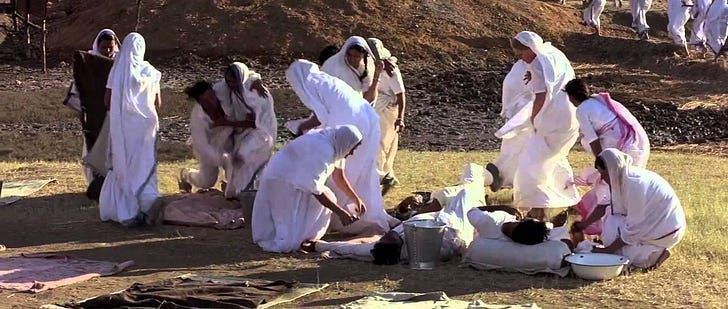
In this scene below from the 1982 film Gandhi, Gandhi’s followers march to the British-controlled Dharasana salt works. (Salt is an important commodity because it preserves food before refrigeration.) As you watch, note the motivational speech: “They expect us to lose heart or fight back.” Losing heart or fighting back means remaining in the authoritarian-narcissistic dynamic. How does this protest avoid this? How does the reporter at the end of the clip use the moment to articulate truth?
The next two clips re-enact the first US Civil Rights march over the Edmund Pettus Bridge. Watch how nonviolent coordination is practiced in this re-enactment, as well as how the press and public respond. What are the similarities to and differences from the march on the salt works? Why might this protest not look exactly like the one portrayed in Gandhi?
Now that you’ve seen re-enactments of Satyagraha/nonviolent coordination that portray strategy, personal resolve, and outcomes, below is the original footage for comparison. I’ve double-checked the links to YouTube. Let me know if you can’t view the clips. (Interestingly, YouTube doesn’t impose age restrictions on violent re-enactments, but limits viewing of original footage.)
Next time we will explore nonviolent resistance in the French village of Le Chambon-sur-Lignon under the Vichy regime and later, Nazi occupation. From May 1940 until September 1944, it would have been too dangerous for the villagers to openly protest, so they found other, mostly silent forms of nonviolent resistance for sheltering 5,000 Jewish children. The resistance leadership there was directly influenced by Gandhi’s Satyagraha.
Dandi March, Satyagraha for Salt in India
“Bloody Sunday” in Selma at youtu.be/a6InULio9fo?si=qh694SxKuvoRr_1U. This video may be restricted without confirmation of viewer age.
See my discussion of the Arendtian concept of totalitarian prophecy in R. T. Greenwald, “Arendt, Iran, and the Seduction of Certainty: Ceci n’est pas un président--Conversation 2.1,” The Elephant in the Room (Substack), July 11, 2025. ↩
Weapons of the Spirit, directed by Pierre Sauvage (Los Angeles: Chambon Foundation, 1989), documentary film. ↩
R. T. Greenwald, “Awe, Adoration, and Ear Bandages: Inside the Psychological Dynamics of Authoritarian Politics,” The Elephant in the Room (Substack), August 4, 2025; R. T. Greenwald, “The Psychological Dynamics of Authoritarian Politics: An Interview with Dr. Simon Rogoff, Part I,” The Elephant in the Room (Substack), September 26, 2025; R. T. Greenwald, “Part II: The Psychological Dynamics of Authoritarian Politics—A Conversation with Dr. Simon Rogoff,” The Elephant in the Room (Substack), October 3, 2025. ↩
New World Encyclopedia contributors, “Satyagraha,” New World Encyclopedia, , https://www.newworldencyclopedia.org/p/index.php?title=Satyagraha&oldid=1034769 (accessed October 14, 2025). ↩