Why Antisemitism Is Hannah Arendt's First Topic for The Origins of Totalitarianism: Conversation 1.1
What Hannah Arendt Can Teach Us Now: An Elephant in the Room Series
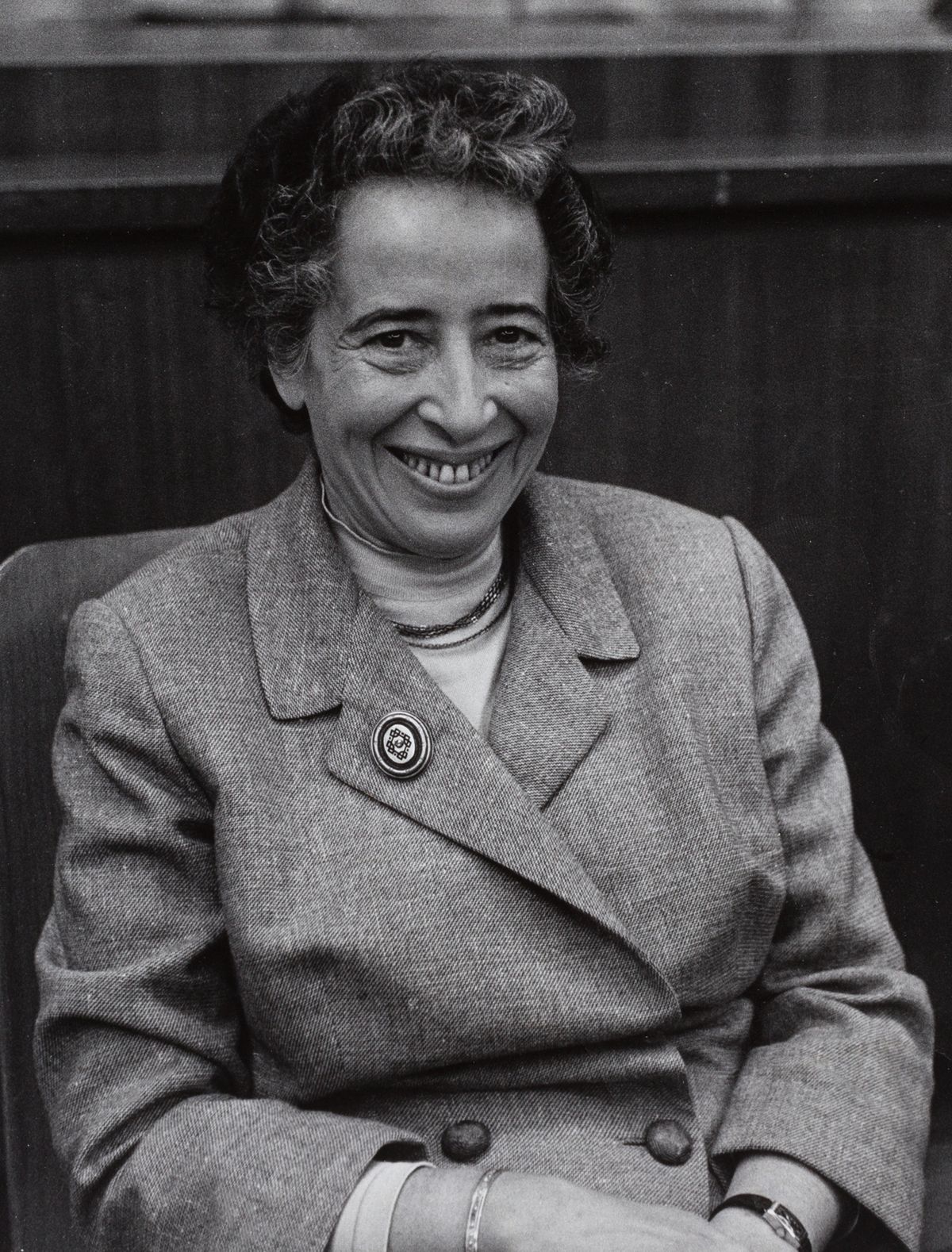
In May 1941, Hannah Arendt made it to the New York City Harbor after slipping out of Nazi Germany in 1933, enduring brief Gestapo detention, several precarious refugee years in Paris, and internment at Gurs. Within a decade she would publish The Origins of Totalitarianism (1951), a 604‑page reckoning with modern tyranny that propelled her into the first rank of political thinkers.
What still jolts first‑time readers is her decision to open that vast study with a 156‑page section on nineteenth‑ and twentieth‑century antisemitism—fully one‑quarter of the book, before she ever utters the words “imperialism” or “totalitarianism.”
Today’s Conversation is about why antisemitism is Hannah Arendt’s first topic for The Origins of Totalitarianism. For a woman who had herself been rendered stateless, beginning the story there was no scholarly quirk, and I’d like us to consider why.
If you are just joining this series, please read the introduction to this series, as well as the explanation of how this series is structured and why it is different from opinion essays.
Keep the following in mind as you read through conversations: The first half is for the casual reader. In the middle, I provide questions and quotes for consideration. The second half is meant for those who want a deeper dive into the material. At the very bottom, I provide a bonus question for everyone.
Conversations like this rely on civil discourse that remains on topic. Please keep this in mind as we engage in discussion. If you prefer anonymity, but want to comment, send me a DM. Please exercise discretion if you choose this option.
Nineteenth- and twentieth-century antisemitism isn’t a passing reference in Hannah Arendt’s work. Her discussion of the topic isn’t even just a few paragraphs. She devotes, in fact, the first 156 pages of 604 to the topic (Penguin Classics iPhone edition).
This means the topic is important for her overall understanding of totalitarian regimes. How important? Let’s start by looking at the Table of Contents (TOC).
- Antisemitism, page 1
- Imperialism, page 157
- Totalitarianism, page 397
This TOC — or any TOC, for that matter — may seem just plain utilitarian at first. Perhaps it doesn’t seem very interesting – or even sexy, but how a thinker structures a book-length manuscript tells the reader what to expect. The author emphasizes what is important and what the reader needs to keep in mind as the book heads toward a conclusion.
Here’s a comparison that can help interpret TOCs in general, not just as part of our conversation: There is a Coen Brothers film, Fargo. The title at first seems very simple. It’s just a place name. Fargo, ND is where the action begins. It’s where decisions are being made that seem fairly innocuous. But the filmmakers don’t want the viewer to forget the place and decisions where the film began. The beginning isn’t a typical setup for action, as is often the case in many movies. In the case of Fargo, it is an invitation to participate in a two-hour evaluation of the action produced. In fact, by the end of the film, it becomes clearer and clearer how these seemingly minor decisions carry great moral weight, not just entertainment value.
Similarly, a TOC tells the reader what to keep in mind at every point in the reading.
So let’s begin the discussion with this in mind. Here are two quotes from Arendt’s analysis of the close connection between antisemitism and totalitarianism:
“In contrast to all other groups, [European] Jews were defined and their position determined by the body politic. Since, however, this body politic had no other social reality, they were, socially speaking, in the void. Their social inequality was quite different from the inequality of the class system; it was again mainly the result of their relationship to the state …” (17).
“Just as the Jews ignored completely the growing tension between state and society, they were also the last to be aware that circumstances had forced them into the center of the conflict. They therefore never knew how to evaluate antisemitism, or rather never recognized the moment when social discrimination changed into a political argument (31).
Use your gut to answer the following questions — just write what comes to mind.
- What is the difference between social discrimination and political argument?
- Why might Jews not be politically engaged?
- Why does Hannah Arendt focus on the state in these quotes?
This second section of the conversation is for readers who want to dive into a more in-depth analysis of The Origins of Totalitarianism.
Arendt’s theories diverge sharply from traditional moralizing treatments of antisemitism. Antisemitism isn’t just about prejudice or hatred in the above quotes. She provides instead an explanation for why Jews are the proverbial “canary in the coal mine.” Given the above quotes and your own knowledge of politics and society consider or make some predictions about:
- What “canary in the coal mine” means in the context of political theory.
- How Arendt will position central European Jews in the changing class structures of 19th and 20th century Europe. Specifically, how do you think she will connect antisemitism to changing economic conditions, national identity, and class dynamics?
- What it means for the political position of European Jews when belonging to a nation becomes the basis for equality. How do Jews fit into calls for new socio-political guarantees, such as universal manhood suffrage, when participation in the nation-state is tied to ethnic origin?
Bonus Question for Everyone: This is a brainstorming exercise that’s designed to help you think about the relationship between hatred and shifting socio-political structures. It is a big question, and it’s meant to be open-ended:
Consider this quote from Origins: “But what drove the Jews into the center of these racial ideologies more than anything else was the even more obvious fact that the pan-movements’ [pan-Germanism and pan-Slavism] claim to chosenness could clash seriously only with the Jewish claim. It did not matter that the Jewish concept had nothing in common with the tribal theories about the divine origin of one’s own people” (314).
If Arendt were alive today, what strategies would she employ to evaluate Holocaust education as a tool against hate?