Global Politics are Local: What the German Press Can Tell Us About the Trump Administration
Finding Patterns in Today's US Politics
The following story broke two hours after this essay was published: “MSC 2025: Germany's Pistorius derides Vance's remarks: German Defense Minister Boris Pistorius criticized US Vice President JD Vance's speech at the Munich Security Conference. Vance claimed freedom of speech is 'in retreat' in Europe.”
The recent destruction of USAID has brought what seemed like far-flung matters into American living rooms. In a country where just 15% of citizens travel abroad and many citizens have never learned a foreign language well enough to speak or read fluently, US foreign policy has suddenly become more interesting at home.
It’s not just the dismantling of USAID that Americans should be concerned with. Shifts in international relations and the flow of money under the Trump administration will influence more than the proverbial price of eggs, which is already high due to the unrelated spread of the avian bird flu. Keeping an eye on the globe is not just important for domestic policy changes and financial outcomes. By paying attention to the foreign press, we can see how the rest of the world is framing our domestic situation and perhaps gain new insight.
The ways in which foreign writers and editors choose and frame their stories can help us understand domestic power systems and where we should focus our energy. Let’s look at one of the biggest issues so far: the current strength of US Democracy and loyalty to the Constitution. Within the US, we have a population divided. One side believes the Trump administration is simply shaking up Washington politics to deliver on his promises. The other side believes the Trump-Musk alliance is directly challenging the US Democratic order.
Abroad, the focus is sharper with much more willingness to believe that the Republic could be upturned, in contrast to some of the American press which may or may not be bending the knee. I will focus on the Federal Republic of Germany, since I have direct experience there. Given Germany’s mid-20th century history with fascism and its extraordinarily destructive results, the country is especially attuned to far-right behavior.
The German-language press has been keeping track of Musk’s financial success around the world and how he has transformed this success into political capital. German writers highlight Musk’s financial interests in far-right administrations, especially since he has been actively campaigning for the Federal Republic’s far-right party, Alternative für Deutschland. In this regard, the German media have been asking themselves where free speech on X ends and election interference begins. The leader of the AfD, Alice Weidel, has made public statements aligning her party with Victor Orbán, the Hungarian autocrat who took advantage of the pandemic to cement his control over the country’s formerly democratic system. It’s worth noting that Trump has praised Orbán and met with him.
Over the past week, Trump himself has taken a back seat to Musk in German reporting. Indeed, Sigmar Gabriel, the former FRG foreign minister, called Trump Musk’s “useful idiot” in an interview with broadcaster Mitteldeutscherrundfunk. While tariffs promoted directly by Trump are of concern, the international soft power vacuum created by DOGE’s gutting of USAID is leaving Germans wondering not only how international influence will shift, but also to what extent Germany is prepared to protect itself financially or can even position itself to take advantage of the situation. In Handelsblatt, a leading financial newspaper, Co-Political Editor, Moritz Koch, noted Germany’s strength in wind power and potential for energy independence (the FRG dismantled its nuclear power plants, leaving Germany more dependent on Russian gas during the Russian-Ukraine War). Coming from a brain power angle, Christian Stöcker, writing for Der Spiegel, saw an opportunity for the European Union to grab US scientists, should scientific funding continue to be curtailed after the reduction in NIH funding.
A brain drain from the past — the German to US brain drain occurred between 1945 and 1959, called Operation Paperclip. More than 1600 German scientists and engineers, many of whom were members of the Nazi party, were brought to the US as part of intelligence operations. The comedy duo, Mike Nichols and Elaine May, offered this take on America’s new brain trust, “The Von Brauns at Home.” (Nichols went on to direct. May became a screenwriter.)
How can German observations about the US domestic situation help us understand our current presidential situation? First and foremost, the Germans have spent many years on Vergangenheitsbewältung — “mastering the past" — and the press is particularly attuned to any political movements that smack of authoritarianism. When in doubt, it’s worth noting headlines and observations that mention the subject in the context of US domestic concerns and foreign relations.
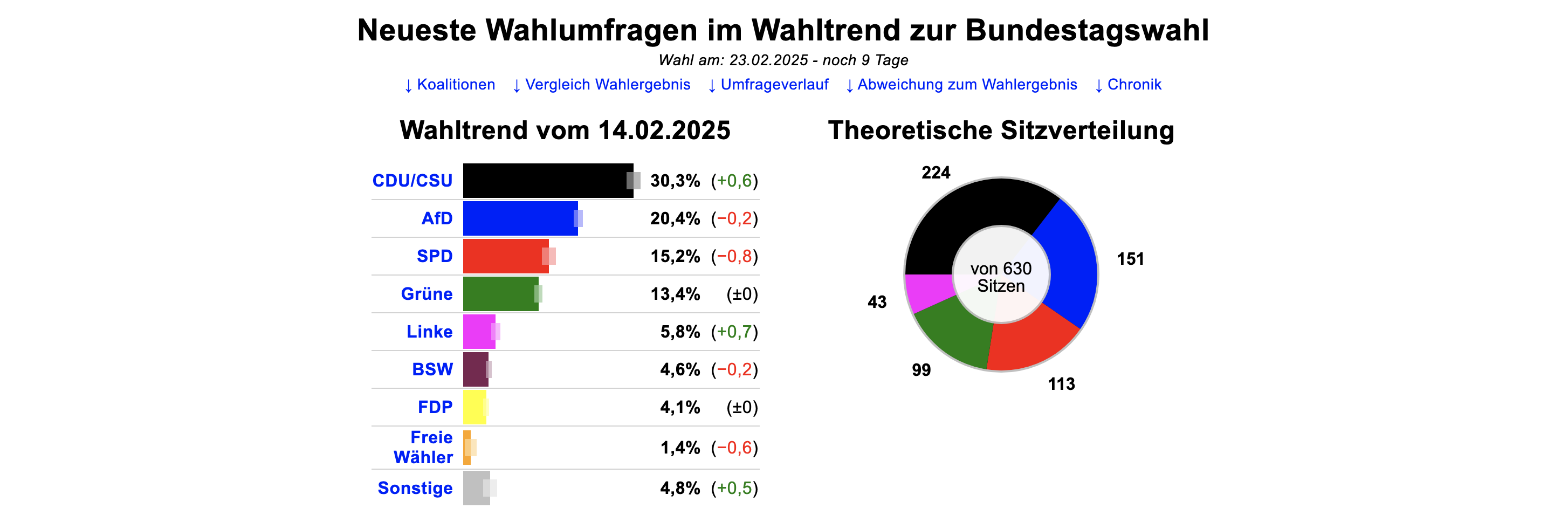
As one of Europe’s economic powerhouses, Germany will also be following Musk’s economic interests in the country closely. We can note his moves there and how they can inform us about his US goals. If the AfD joins the ruling coalition after the February 23, 2025 elections, we should pay attention to how Musk tries to leverage the political shift for his economic gain. The FRG’s current ruling coalition comprises the CDU, the SPD, and the Greens, where the Christian Democrats have traditionally been at ideological loggerheads with the left-wing Social Democrats and the Greens. It is a cordon sanitaire designed to keep the far right at bay. Current polling shows the Christian Democrats, Germany’s leading conservative party, with about 30% of the vote, the AfD with 20%, the Social Democrats (SPD) with 15%, and the Greens with 13%.
In a move to bring supporters of the AfD to vote center-right, Friedrich Merz, leader of the CDU and likely the next prime minister, proposed restoring passport controls at the border. It is a move that violates the Schengen agreement that allows for open borders across most of the European Union, but plays domestically into the current popular demand for greater restrictions. Even if the “Grand Coalition” remains in place, the new government will be under pressure to deliver on its migration promises, something that Elon Musk will likely pay close attention to, and we should be paying attention to as well.
In a sharply divided nation such as the US, where there is no trust in the opposition, foreign observations and analyses are becoming useful to demonstrate the inconsistencies in Trump’s and Musk’s populism. As Hannah Arendt noted in The Origins of Totalitarianism, “What convinces masses are not facts, and not even invented facts,” Hannah Arendt wrote in The Origins of Totalitarianism, “but only the consistency of the system of which they are presumably part.”1
Hannah Arendt, The Origins of Totalitarianism, (NY: Penguin, 1994) 460. ↩