Intention + Moral Clarity = Right Action: Lessons on Moral Courage from Le Chambon to the Bhagavad Gita
What Hannah Arendt Can Teach Us Now: An Elephant in the Room Series
© R.T. Greenwald, 2025. The ideas, arguments, and original frameworks presented here are the intellectual property of the author and require formal citation when referenced or adapted. For permissions, collaborations, or inquiries about appropriate use, please send me a DM.
How do ordinary people, stripped of power and surrounded by danger, still find the strength to act rightly? In today’s piece, I continue exploring Gandhi’s concept of Satyagraha1 in a context where speech and action are heavily constrained: a small village in the mountains of Vichy France that was later occupied by the Nazis in 1942. Every act of moral courage there began not with defiance, but with a quiet refusal to let fear dictate what is true.
In my first piece on the subject of nonviolent resistance, “Authoritarianism and Its Antidote,” we explored how nonviolent coordination removes itself from personal and social dynamics that serve to obscure and distort the truth.2 As we have learned, these dynamics are derived directly from narcissistic relational behavior that is rooted deeply in protecting personal vulnerabilities—the self always takes precedence over others’ well-being. Authoritarian leaders, their inner circle, strongest supporters, and opposition draw directly from this playbook. Leadership and opposition set up situations that aggrandize personal capital, while followers fall in line to maintain a sense of personal safety. No matter how chaotic and nonsensical these situations become, the continued placement of safety above truth can make it seem like order and dignity are prevailing—in the short-term at least. This falsehood sustains an authoritarian regime until terror grips a population, eventually constraining resistance severely.3 Hannah Arendt in The Origins of Totalitarianism recorded this dynamic and made it the backbone of National Socialism and Stalinism. Later, in Eichmann in Jerusalem, she raised important questions about right action in the face of this terror.4
Right action under National Socialism is the subject of today’s piece, including a very special screening for my readers.
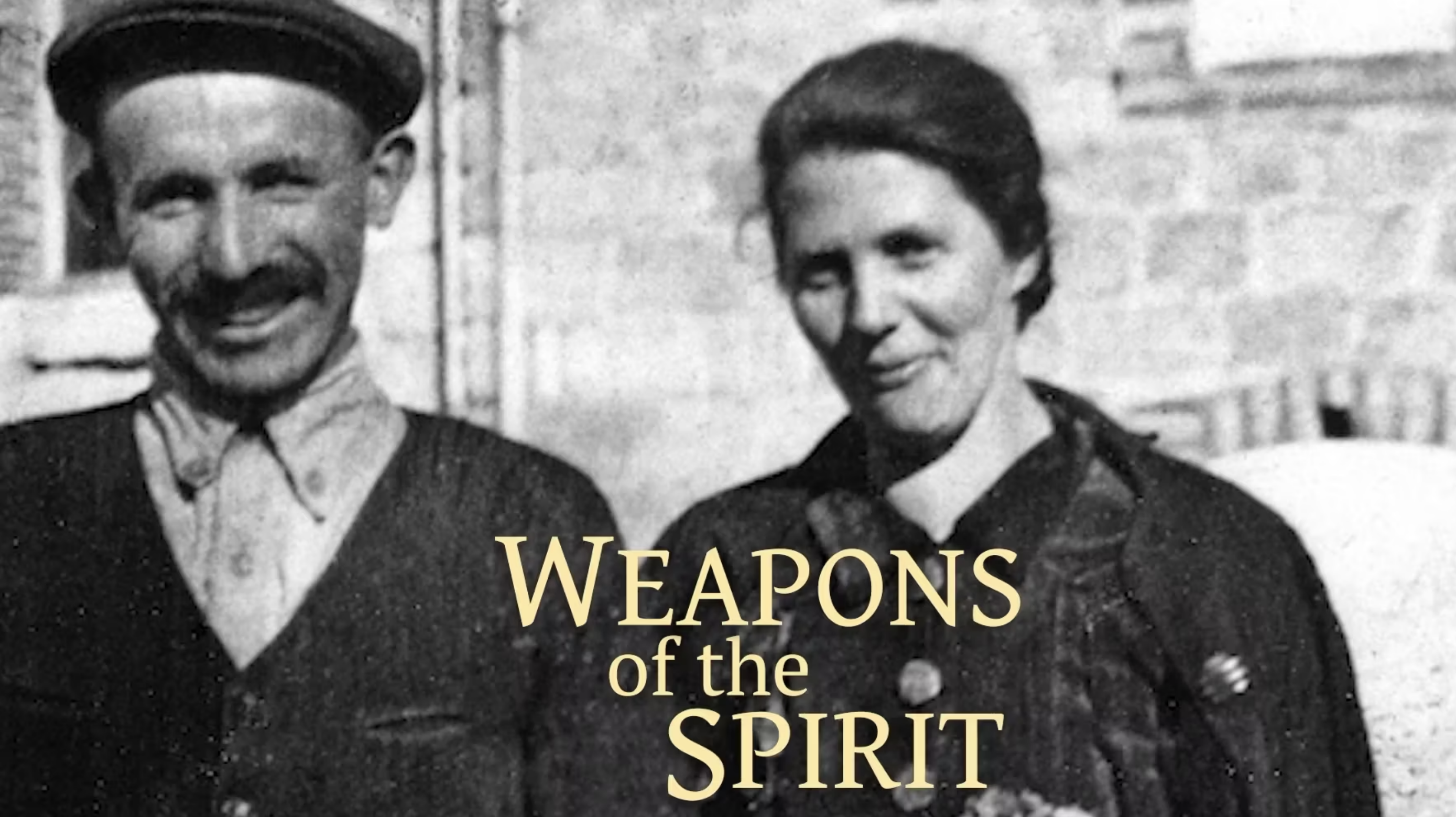
Weapons of the Spirit (dir. Pierre Sauvage, 1987) is one of the most important Holocaust documentaries ever made. It is often screened in proximity to Shoah. While Shoah documents the scope and horror of the Final Solution, Weapons of the Spirit provides a counterpoint in its demonstration of the possibility for effective, right action even under the darkest of circumstances. It tells the story of the village of Le Chambon-sur-Lignon between 1940 and 1945. The entire population of approximately 5,000 residents sheltered about 5,000 Jewish refugees, even under full Nazi occupation. Even more remarkable, there is evidence that towards the end of the war, the purpose and clarity of the villagers brought at least one Vichy official to quietly disobey orders.
Click on this link to view the film: Weapons of the Spirit
When you reach the webpage, “Pierre Sauvage Documentaries,” scroll down to the videos. The one at the top with a runtime of 1:33:21 is the full-length documentary. You may be asked to enter your email and organization. If yes, for the organization, enter “Elephant in the Room, Substack.” This video is not available right now for commercial distribution.
The story behind this film exemplifies Satyagraha in action — an instance where spiritual courage and practical coordination merged to defend truth without violence. Here’s a little background to Le Chambon’s wartime resistance before you watch the film, as well as some thoughts about its larger meaning. The villagers and farmers of Le Chambon initially received direction in Gandhi’s Satyagraha and right action from pastor André Trocmé in his 1940 sermon “Weapons of the Spirit”:
Trocmé exhorted his congregation to shelter “the people of the Bible.” With his wife, Magda, who was also deeply involved in the pacifist movement, he provided direction, strategy, and example. Before he took up his position in Le Chambon, Trocmé was already versed in nonviolent resistance. He helped to establish the French chapter of the International Fellowship of Reconciliation (IFOR), an international pacifist body formed in reaction to the horrors of the First World War and still active today. Satyagraha was embedded in IFOR. A number of its leaders had traveled to India in the 1930s to study with Mahatma Gandhi and learn the principles of nonviolent coordination.6 (Please note that your writer disagrees strongly that nonviolence would have deterred the Nazi war machine. Any nonviolent coordination would have needed widespread support and completely different international and domestic configurations during the interwar period.)
In turn, the villagers of Le Chambon, as the descendants of Huguenots, understood the dynamics and costs of persecution and committed themselves to right action. One of the reasons this form of resistance worked, in my opinion, is that the Trocmés and the villagers never established an actual resistance organization. Such an organization would have made an easy target since authoritarian-narcissistic systems rely heavily on adversarial relationships to aggrandize and maintain power. By operating informally, the people of Le Chambon remained outside the authoritarian-narcissistic dynamic, leaving just a few as its main targets instead of the actual rescue operations.
This is an important lesson for Americans today. Long before burgeoning authoritarianism metastasizes in the United States, I am seeing an unwarranted drop in morale in favor of mourning and misery. However undemocratically US leadership on both sides of the aisle is behaving, we are nowhere near a complete destruction of this country, its laws, and its principles as laid out in our founding documents. We still have freedoms at the end of 2025 that weren’t imaginable in Le Chambon during the early 1940s. I therefore consider it far more productive right now to consider both how we resist and how we prepare ourselves to resist, rather than grieve.
The deeper question that arises from Le Chambon’s example—and from all acts of nonviolent courage—is how do we find the strength for right action in times of spiritual plague? Today’s answer came from Christian theology, a perspective that requires surrender to divine will. Pastor Trocmé told his congregation to obey the Gospel and resist orders contrary to the words of Jesus with “weapons of the spirit.” In my own faith background, Judaism, covenant with the divine demands that we engage with and interpret biblical texts to navigate uncertainty. Jews argue for justice—most famously, three rabbis in Auschwitz put God on trial for the fate of European Jews.
But for today, I want to leave you with a simple story about right action from the Bhagavad Gita, the central text of Hinduism. Hinduism answers the question with duty and detachment from outcomes. I have chosen this text not only because Gandhi developed Satyagraha partly out of his own faith tradition—reading the Gita allegorically in terms of inner struggle—but also because it illustrates in a very relatable manner the kind of chaos and confusion that Americans are facing; it also provides an easy-to-understand way to move past anger and despair into long-term resistance. Please note that I am in no way advocating for a particular faith or theism itself, especially since I can be a real skeptic myself. I am drawing on religious traditions simply because they have all provided thoughtful answers to uncertain times over millennia.
Here’s the scene: The warrior-prince Arjuna is on the battlefield of Kurukshetra. He surveys the opposing army and recognizes grandfathers, uncles, cousins, nephews, friends, teachers, and allied kings. He is overcome as he realizes that he must kill family, friends, and mentors, then collapses. His chariot driver, Lord Krishna, approaches Arjuna, first instructing him in how duty defines his approach to this battle; however, Arjuna struggles to reconcile this teaching with his anguish, unable to translate principle into action. It is in response to this paralysis that Krishna reveals his divine form, a “Vishvarupa” in Sanskrit—a vision that is beyond what humans can normally withstand. The Vishvarupa illustrates plainly that the outcome of the battle is predetermined in the cosmic order of things—those whom Arjuna wants to save by putting down his bow are already dead, whether Arjuna participates or not.
The Gita makes clear that if Arjuna had not fought the battle—a battle that on the surface seemed wrong—there would have been far worse outcomes. Refusing to engage in battle would have:
Created a power vacuum that would have been filled with greater injustice.
Produced “thoughtlessness” in Hannah Arendt’s terminology,7 meaning a refusal to judge and act when required, which in turn would have led to the destruction of the self.
Led to an abdication of leadership, encouraging Arjuna’s subjects to descend into cowardice and retreat, further eroding ethics.
Confused empathy for truth—a form of disorder and distortion that erodes conscience.
Do you recognize these problems in American society today? The point of the Gita and answers provided by other faith traditions—put in secular terms—is that while we humans can’t always comprehend the order of things, we can nevertheless separate truth from distortion and act with integrity. Using the freedom available within our social positions, as well as the clarity of conscience that makes discernment possible, we have the free will to overcome fear and make choices in even the most constrained of circumstances. Arjuna’s hesitation threatened to create that sort of vacuum, something that Hannah Arendt and André Trocmé recognized in the moral collapse that followed when those capable of discernment retreated from responsibility. Le Chambon’s residents understood, likewise, the terrible consequences of not acting based on their own history and relationship to the Protestant Reformation.
In my next piece, I’ll turn from the Holocaust to the public square—a women’s strike in Iceland and sex refusal in Liberia—where the “second sex” without weapons or formal power stepped out of the millennia-old narcissistic dynamic between men and women to transform refusal into witnessing and secular revelation.
In the meantime, here are some study questions for the film:
- Why were André and Magda Trocmé suited for the type of resistance they spearheaded in Le Chambon?
- Why were the villagers of Le Chambon prepared to take on such an enormous and dangerous task?
- What role do personal conscience and self-conception play? How do these factors provide the spiritual strength for resistance?
- What strategies were used to keep the rescue operations secret? How do they accord with and utilize Hannah Arendt’s observations about totalitarianism and atomization?
- How do these strategies become contagious without overt promotion? What relationship do these strategies have to the authoritarian-narcissistic dynamic Hannah Arendt describes in The Origins of Totalitarianism?
- How does the Christianity of Le Chambon defy the history of Jewish-Christian animosity?
And if you would like to learn more about the Bhagavad Gita, I recommend the following sources:
- Edward Viljoen, The Bhagavad Gita: The Song of God Retold in Simplified English (St. Martin’s Essentials, 2019).
- The Bhagavad Gita Explained In 10 Minutes
- The Bhagavad gita drama- -by the Bhaktivedanta Players
See R. T. Greenwald, “Authoritarianism and Its Antidote: Arendt Meets Gandhi in the Age of Trumpian Narcissism,” The Elephant in the Room (Substack), October 14, 2025. ↩
Ibid. ↩
See R. T. Greenwald, “Awe, Adoration, and Ear Bandages: Inside the Psychological Dynamics of Authoritarian Politics,” The Elephant in the Room (Substack), August 4, 2025; R. T. Greenwald, “The Psychological Dynamics of Authoritarian Politics: An Interview with Dr. Simon Rogoff, Part I,” The Elephant in the Room (Substack), September 26, 2025; R. T. Greenwald, “Part II: The Psychological Dynamics of Authoritarian Politics—A Conversation with Dr. Simon Rogoff,” The Elephant in the Room (Substack), October 3, 2025. ↩
Hannah Arendt, The Origins of Totalitarianism (New York: Harcourt, Brace, 1951); Hannah Arendt, Eichmann in Jerusalem: A Report on the Banality of Evil (New York: Viking Press, 1963). ↩
United States Holocaust Memorial Museum, “Pastor André Trocmé and His Wife Magda Trocme Rescued a Large Number of Jewish Children during World War II,” Collections Search, United States Holocaust Memorial Museum, accessed October 28, 2025, https://collections.ushmm.org/search/catalog/pa16304. ↩
Yad Vashem, “André and Magda Trocmé,” Yad Vashem: The World Holocaust Remembrance Center, accessed October 28, 2025, https://www.yadvashem.org/righteous/stories/trocme.html?utm_source=chatgpt.com. ↩
Internet Encyclopedia of Philosophy. “Hannah Arendt (1906–1975).” Accessed October 28, 2025. https://iep.utm.edu/arendt/ ↩