Political Judgment vs. Poetic Justice: Hannah Arendt on Early 20th-Century Jewish Responses to Antisemitism, Conversation 1.5
What Hannah Arendt Can Teach Us Now: An Elephant in the Room Series
© R.T. Greenwald, 2025. The ideas, arguments, and original frameworks presented here are the intellectual property of the author and require formal citation when referenced or adapted.
Today, I’ll be discussing a difficult topic: Arendt’s analysis of the Jewish response to antisemitism. As you may recall, Arendt defines antisemitism as a political tool that harnesses social hatreds. But Arendt doesn’t leave the matter there. She is willing to take on Jewish responses to this kind of politics, particularly behaviors from the Jewish community that she considers politically inept and counterproductive.
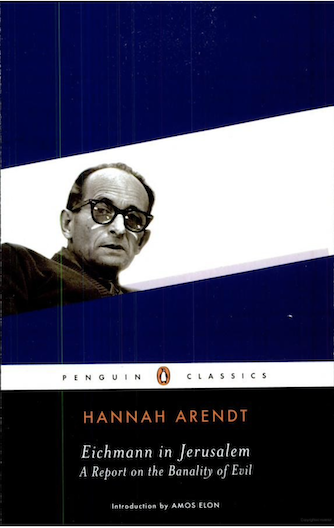
To understand how Arendt portrays Jewish actions within political systems, I’m introducing into today’s conversation her work Eichmann in Jerusalem: A Report on the Banality of Evil. It is a compilation of her reporting on the 1961 trial of Adolf Eichmann for The New Yorker, published thirteen years after the publication of The Origins of Totalitarianism.
(See What Hannah Arendt Can Teach Us Now and A Guide to the Upcoming Conversation on Hannah Arendt for a guide to this series.)
Origins includes Arendt’s observations as a German Jew and a refugee from Nazi Europe. By the time she was writing for The New Yorker, there was greater research available that confirmed her observations about Jewish political behavior, particularly the ways it caused more problems than it solved. This willingness to address cracks in the 20th-century Jewish narrative during the 1960s was often met with rejection in the initial decades after publication. Arendt, in fact, lost many friends, although 300 people still attended her funeral in 1975. At a time when the Jewish community was looking for poetic justice, Arendt offered the exact opposite: irony and complexity. She focused on Eichmann as a laughable, thoughtless figure—not a sinister character one would usually find in melodrama, the dominant theater form of our times.
According to Arendt, evil was not embodied in Eichmann as arch-villain; it was neither easily recognizable nor overtly menacing. On the contrary, it was discoverable by observing the lack of thought Eichmann gave to the fulfillment of his duties. Loyalty—less so intention—was Eichmann’s maleficence. This kind of analysis alone would have caused profound dissonance within Jewish communities only twenty years after the Holocaust. Yet, Arendt chooses to continue with an even more destabilizing observation: This same thoughtlessness in service of consistently evil intentions could produce positive results. One of the great ironies of Eichmann’s dutiful work for the Nazi Party is that he produced a program that saved a great number of Jews. Your writer is able to publish this Substack piece today because of Eichmann’s programs to make Austria judenrein—a perverse irony that Arendt herself would not have hesitated to highlight.
But Arendt didn’t stop there. As if this cognitive one-two punch against the protagonist-antagonist narrative weren’t enough, Arendt dared right from the first page to reveal some of the absurdities coming from the newly formed Israeli community. With tongue in cheek, she observes the inability of the Israelis to provide a good German interpreter during the trial:
“[T]he German-speaking accused party, like almost everyone else in the audience, follows the Hebrew proceedings through the simultaneous radio transmission, which is excellent in French, bearable in English, and sheer comedy, frequently incomprehensible, in German. (In view of the scrupulous fairness of all technical arrangements for the trial, it is among the minor mysteries of the new State of Israel that, with its high percentage of German-born people, it was unable to find an adequate translator into the only language the accused and his counsel could understand … )” (40).
It was this tone of voice that may have alienated those who sought poetic justice, not self-examination. Perhaps Arendt intended the irony to be thought-provoking or even a means to soften the blow of her analytical juxtapositions. However, without some introduction as to its purpose and context, this rhetorical device was probably, as comedians say, “too soon.”
(See our May 16 conversation,“Comparing Hannah Arendt and South Park” for a discussion of juxtaposition and context.)
Before I continue with today’s topic of Jewish political behavior, I want to address this misstep. Writers can be baffled by this situation, especially since Arendt was strongly attuned to the symbiotic relationship between actors and political systems. How could she misjudge this delicate situation? Some commentaries and biographies point to her exceptional focus on logos at the expense of pathos and tribalism. Perhaps she couldn’t understand the emotional attachment to triumph and justice?
I have a different take, although her devotion to thought certainly could have contributed: After fleeing to the USA, Arendt lived and worked in New York City. Irony was—and still is—de rigeur in this context, unlike in other parts of the United States, where it is often considered insolent and disrespectful. With so little experience with the wider American culture, she may have misjudged the impact of ironic commentary — especially coming from a woman. Her editors, also steeped in New York City culture, may have misjudged the impact as well.
Her status as émigrée became even more important when she was asked to write on a very different topic. In 1959, Arendt was asked to discuss Brown v. Board of Education in the magazine Dissent. The editors published her piece, “Reflections on Little Rock,” but with a strong disclaimer that distanced the magazine from the following arguments: Arendt acknowledged that a democracy requires equality before the law. However, outside the realm of politics, the social sphere should take over; children especially shouldn’t be used in political battles.
We can see here that Arendt strongly underestimated the extent to which the social sphere can be used to undermine rights and political participation. Over time, she may have quietly distanced herself from this position as she neither referenced nor republished it later in her career. As an émigrée who learned to behave like an American in New York City’s narrow intellectual culture, she may not have had enough cultural knowledge, especially of the Deep South, to assess the battle against segregation well. Nevertheless, it is also important to note that she never disavowed her positions publicly either, and it is possible that her analysis, however problematic we consider it today, reflected the prejudices of the fin-de-siècle European context in which she was born and raised. While this context informed her extraordinary political analysis of twentieth-century Europe, it left her poorly informed about some of the political dynamics of the United States. Great intellectuals can have fails too.
It is now 60 years since the Eichmann trial. Her specific concerns about Jewish behavior may be more appreciated today as there is an enormous global uptick in antisemitism. One hundred years since the descent of Europe into fascism, Jews may very well be repeating some of the mistakes that Arendt identified, including not being prepared for this onslaught and difficulty attempting a coordinated, effective response. This approach isn’t victim blaming. It is asking historical actors to assess their historical context well and find appropriate strategies. Arendt wanted to demonstrate that agency was possible, so possible in fact, that she thought it was worth exposing the many missteps and missed opportunities. I’m hoping that my discussion of them will be met with more openness and forgiveness from the Jewish community today than was understandably available in the mid-1960s.
Today’s quotes from Arendt address these concerns. The first three are from Eichmann in Jerusalem. The last two are from The Origins of Totalitarianism. Much as playwright Harold Pinter—and the television show Seinfeld, following Pinter’s lead—use backwards action to highlight the developing timeline leading up to the outcome, I’d like us to consider first, the empirical evidence Arendt presents in the 1960s, then her theoretical concerns written in the late 1940s:
- What problems in Jewish behavior does Arendt identify?
- What juxtapositions does she make to reveal these problems? How do these problems relate to the political context Jews had to contend with?
- Why might Jewish readers take offense at Arendt’s analysis and why might they disregard her first-person observations?
- What issues does she raise that may apply to American antisemitism and the Jewish response?
- How does coordinated Jewish action — or the lack thereof — act as a “canary in the coal mine” today for the larger American difficulties to counteract burgeoning authoritarianism?
Eichmann in Jerusalem,167-168: “According to the story told by Jon and David Kimche, with “the full and generous cooperation of all the chief actors” (The Secret Roads: The “Illegal” Migration of a People, 1938-1948, London, 1954), these Jews from Palestine spoke a language not totally different from that of Eichmann. They had been sent to Europe by the communal settlements in Palestine, and they were not interested in rescue operations: “That was not their job.” They wanted to select “suitable material,” and their chief enemy, prior to the extermination program, was not those who made life impossible for Jews in the old countries, Germany or Austria, but those [the British] who barred access to the new homeland … .”
Eichmann in Jerusalem, 168:“Indeed, [the Jews from Palestine] were in a position to deal with the Nazi authorities on a footing amounting to equality, which native Jews were not, since they enjoyed the protection of the [British] mandatory power; they were probably among the first Jews to talk openly about mutual interests and were certainly the first to be given permission “to pick young Jewish pioneers” from among the Jews in the concentration camps. Of course, they were unaware of the sinister implications of this deal, which still lay in the future; but they too somehow believed that if it was a question of selecting Jews for survival, the Jews should do the selecting themselves.”
Eichmann in Jerusalem, 169: “It was this fundamental error in judgment that eventually led to a situation in which the non-selected majority of Jews inevitably found themselves confronted with two enemies—the Nazi authorities and the Jewish authorities. As far as the Viennese episode is concerned, Eichmann’s preposterous claim to have saved hundreds of thousands of Jewish lives, which was laughed out of court, finds strange support in the considered judgment of the Jewish historians, the Kimches.”
Origins, 82-83: “But one should also bear in mind that lack of [Jewish] political ability and judgment have been caused by the very nature of Jewish history, the history of a people without a government, without a country, and without a language. Jewish history offers the extraordinary spectacle of a people, unique in this respect, which began its history with a well-defined concept of history and an almost conscious resolution to achieve a well-circumscribed plan on earth and then, without giving up this concept, avoided all political action for two thousand years. The result was that the political history of the Jewish people became even more dependent upon unforeseen, accidental factors than the history of other nations, so that the Jews stumbled from one role to the other and accepted responsibility for none.”
Origins, 84:“It is quite remarkable that the only two doctrines which at least attempt to explain the political significance of the antisemitic movement deny all specific Jewish responsibility and refuse to discuss matters in specific historical terms. In this inherent negation of the significance of human behavior, they bear a terrible resemblance to those modern practices and forms of government which, by means of arbitrary terror, liquidate the very possibility of human activity. Somehow in the extermination camps Jews were murdered as if in accordance with the explanation these doctrines had given of why they were hated: regardless of what they had done or omitted to do, regardless of vice or virtue. Moreover, the murderers themselves, only obeying orders and proud of their passionless efficiency, uncannily resembled the ‘innocent’ instruments of an inhuman impersonal course of events which the doctrine of eternal antisemitism had considered them to be.”
And for those who want a deeper dive …
- How does Arendt’s concept of the “banality of evil” push against prevailing legal or psychological theories of culpability? Does this concept align with how we determine cause and effect in legal contexts?
- Does her portrait of Eichmann suggest a deeper indictment of bureaucratic modernity—or is it more a cautionary tale about the dangers of unthinking obedience?
- In what ways does Arendt’s attention to internal hierarchies within Jewish communities during the Holocaust reflect her skepticism of national identity as a guarantor of justice? How does this instance illustrate the danger of mimicking the logic of one’s oppressor?
- How does Arendt's concept of “thoughtlessness” apply not only to perpetrators but also to communal responses? Can this dual-enemy framing be reconciled with her insistence on distinguishing between guilt and responsibility?
I’m skipping the brainstorming question this week since this conversation has been particularly long. Instead, I invite everyone to check out Harold Pinter’s backwards play Betrayal, as well as the Seinfeld parody of it, “The Betrayal” (Season 9, Episode 8). Both demonstrate how altering context and the use of juxtaposition help create alternative, deeper interpretations. I couldn’t find free performances online, but the link below might work for Seinfeld.
For permissions, collaborations, or inquiries about appropriate use, please send me a DM.