Signal vs. Threat: Misrepresentations of Indirect Speech and Their Role in This Presidential Election
What is the difference between a signal and a threat?
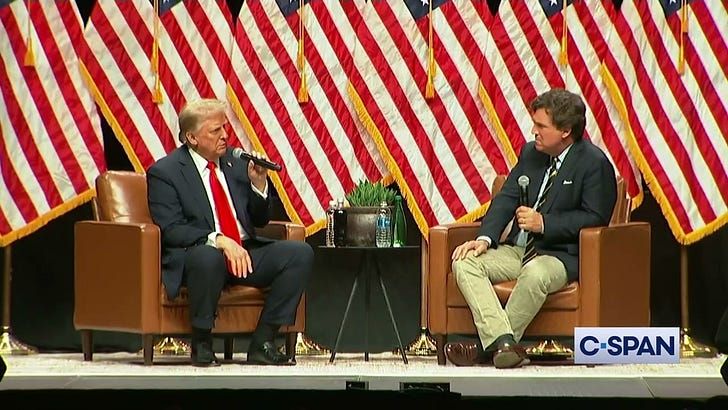
On Thursday, Trump used firing squad imagery in his discussion of Liz Cheney’s “hawkishness.”
It is worth watching the original exchange to understand the full context:
I published a note recently in which I retracted my repetition of the message that Trump’s recent statements were a threat. In response, a commenter noted that Trump has used disturbing imagery before to suggest impending danger to his opponents.
This response to my note was an important point, but the distinction between a signal and a threat is also important, because the ambiguity in a signal leaves doubt in the public mind and is much harder to prove. As such, a signal is more dangerous because we don’t seem to have adequate legal means right now to make larger contextualized and circumstantial arguments to prove intent to harm.
Perhaps the press is choosing to use “threat” as a shorthand to illustrate the danger inherent in this type of speech. I believe that is a mistake. There is a great loss of trust in this country due to frequent hyperbole and mischaracterizations from both the right and the left. It would be better if the press explained how signals work and why these sorts of statements from Trump are dangerous. Instead, the ambiguity is allowed to stand, making it less likely that we will have a public discussion of ways to hold people accountable for this type of speech.
Given the challenges in our current legal and social frameworks to address fully language that conveys harmful intent, a discussion on accountability is much needed. Although the 1919 Supreme Court decisions, famously citing the prohibition against "shouting fire in a crowded theater," allowed broad restrictions on speech that resulted in overreach, the 1969 Brandenburg v. Ohio ruling narrowed this scope, requiring that speech must be shown to incite "imminent lawless action" in order to be restricted. This change, however, has made it difficult to address signals or innuendo. Developing standards to recognize these subtle cues without dismissing them as harmless could help create a foundation for accountability when language indirectly encourages harm.
I want to note that there may be a general trend of underestimating the public’s understanding of context. Moviegoers, for example, understand the signals portrayed in depictions of organized crime, such as “Why don’t you take the pressure off yourself?” or “We wouldn’t want anything to happen to your family.”
Consider how the situation might look now in Pennsylvania—where the Jewish vote may make or break Harris’ candidacy—if more of the press had explained how signals work to their readers. There have been outcries from the Jewish community for over a year now about the whitewashing of violence against Jews on college campuses. I wrote about the dismissal of the violent nature of this speech in May. It has been obvious to many American Jews, and many center- and right-leaning members of the general public, that pro-Palestinian protests have escalated beyond peaceful demonstrations, crossing into intimidation under the guise of free speech. Sometimes the intimidation was realized in physically violent behavior.
At Columbia University, for example, pro-Palestinian protests intensified, culminating in the storming of Hamilton Hall on April 30, 2024. Protesters barricaded themselves inside and took four janitorial staff members hostage. Until this point, protesters claimed they were nonviolent, and the liberal press bought into this narrative, dismissing the signals of animus. Journalism from the right, however, most notably the New York Post, got it right.
The media bears a responsibility to avoid oversimplifying potentially harmful rhetoric as “threats” or “free speech.” By accurately distinguishing signals and providing context, they can better inform readers and reduce polarized interpretations, fostering a more nuanced understanding of the language that shapes public discourse. The American public is smart enough to understand these nuances, and we deserve better.