The Elephant in the Mandate: The Haunting behind Contemporary Jewish Divisions, Conversation 1.6
What Hannah Arendt Can Teach Us Now: An Elephant in the Room Series
© R.T. Greenwald, 2025. The ideas, arguments, and original frameworks presented here are the intellectual property of the author and require formal citation when referenced or adapted.
Today’s conversation broadens our discussion of Arendt’s analysis of 19th and 20th-century antisemitism to the current political situation. One subscriber recently suggested reading Dara Horn’s "Is Holocaust Education Making Anti-Semitism Worse?" I’m also linking Horn’s follow-up a year and a half later, as well as a Tikkun video conversation that includes Horn, Harvard Professor of Comparative Literature emerita Ruth Wisse, Israeli journalist Liel Leibovitz, and Wall Street Journal editor Elliot Kaufman.
To facilitate discussion of Arendt’s theories in today’s context, I am opening up the Elephant in the Room chat. Also, feel free to use the comments section if you are more comfortable posting there. I will not be providing specific questions in order to keep the discussion wide open.
New readers see What Hannah Arendt Can Teach Us Now and A Guide to the Upcoming Conversation on Hannah Arendt for a guide to this series.
Please note: Given the swiftness of events last week, including widely attended protests against Trump, I will accelerate future conversations about The Origins of Totalitarianism. Rather than diving into the second part of the book on Imperialism exclusively, I will work back and forth between this section and the third and final section titled “Totalitarianism.”
Last time, I provided five quotes from Arendt's Eichmann in Jerusalem: A Report on the Banality of Evil and The Origins of Totalitarianism, both of which offer pointed critiques of Jewish behavior historically in the face of antisemitism. She gives special emphasis to Jews remaining outside of politics rather than organizing to defend their interests.
As we saw last time in Arendt’s texts, the lack of European Jewish political participation became particularly detrimental during the rise of National Socialism. Under Nazi pressure, German-Jewish interests remained fragmented. This left the population vulnerable to the whims of individual actors and organizations. The passages I chose last time from Eichmann in Jerusalem and The Origins of Totalitarianism highlight one of the most egregious situations Arendt addressed: Opportunities for Jews to emigrate to Palestine under the British Mandate were limited because of the political goals of Jewish leadership in the region. Leadership in the Yishuv (the proto-Israeli community), according to historians Jon and David Kimche cited by Arendt, focused on selecting "suitable material" for immigration, rather than prioritizing rescue efforts. This focus on “suitable material” created a political situation where Jews under the Mandate considered their main adversaries at the time not the Nazis, but the British, who were restricting immigration.
The focus on “suitable material” brings to the fore some troubling realities:
There was not only a crisis of Jewish leadership locally and internationally, but leadership could operate purposely at the expense of the Jewish populations under threat: “It was this fundamental error in judgment that eventually led to a situation in which the non-selected majority of Jews inevitably found themselves confronted with two enemies—the Nazi authorities and the Jewish authorities” (Eichmann in Jerusalem, 167-168).
Selecting “suitable material” was eerily reminiscent of the eugenicist thinking of the late 19th and early 20th centuries, a widespread belief in national regeneration through selective reproduction and physical renewal. Arendt notes this way of thinking just five years after the liberation of the camps without specifically naming the ideology, and fragments of it are confirmed in analyses of emigration programs.1
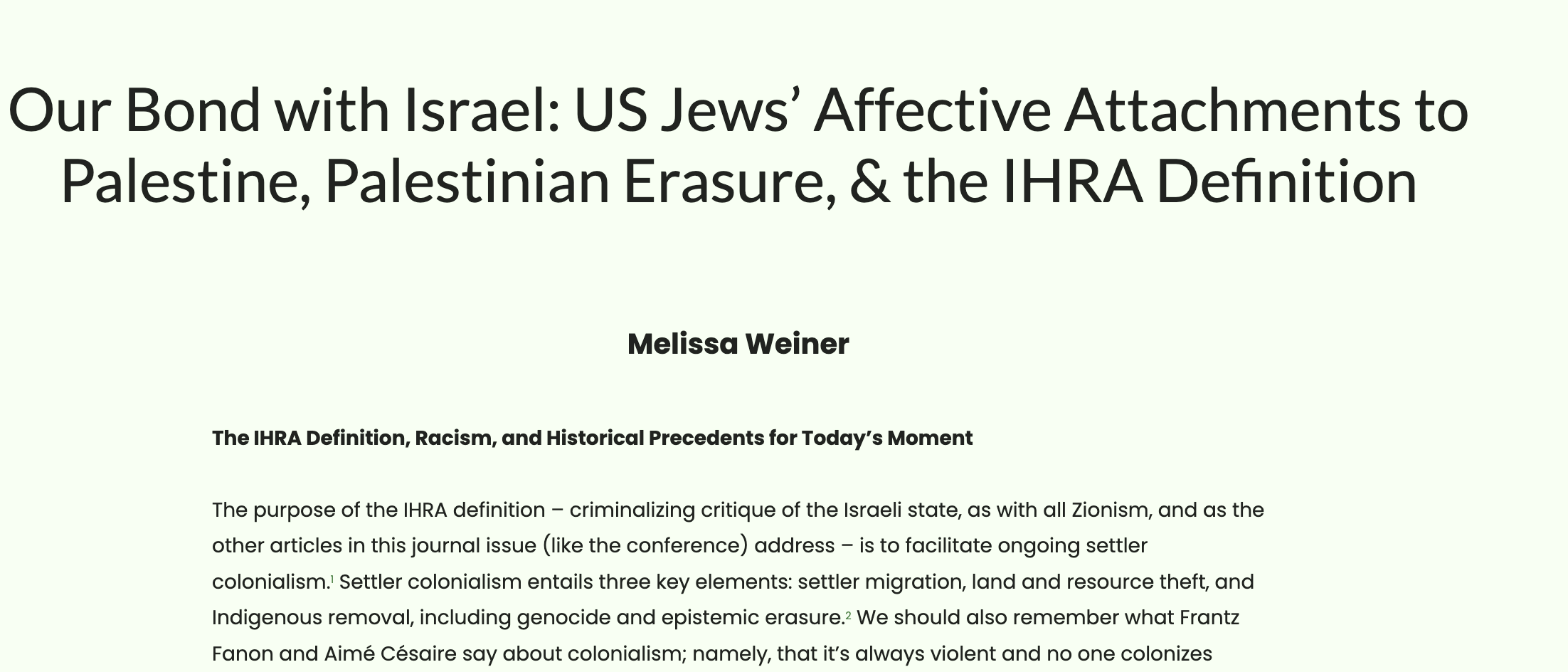
I am willing to name the ideology eighty years later. I realize that openly naming “eugenics” is a risky move right now, maybe even riskier than Arendt’s rejection of poetic justice in her reporting on the Eichmann trial. It lurks in the background today first and foremost as an unnamed weapon against world Jewry and the state of Israel. Antisemitism, especially pro-Hamas propaganda, relies on this hundred-year-old historical context for its accusations of contemporary Jewish human rights violations that it portrays as equivalent to those of National Socialism. There are indeed anti-Zionist publications that use Youth Aliyah rhetoric as evidence for the original sin in the founding of the Jewish State, carried over to anyone who supports it:2
But to be clear, acknowledging these historical contradictions is not an indictment of Zionism or Jewish continuity. Rather, it helps us see how trauma, ideology, political judgment, and human vulnerability intersect—sometimes tragically—in efforts to build safety in an unsafe world. These are entanglements Arendt herself worked tirelessly to expose without surrendering to cynicism or dogma.
These same entanglements are dividing the Jewish community here in the United States today. It is behind the Progressive Jewish focus on universal human rights and its rejection of Israel,3 as well as this wing’s denial of hate crimes against Jewish Americans—crimes that have been witnessed by many Americans over and over again live on television and social media. It also is the elephant in the room for supporters of Zionism as they attempt to distinguish the need for personal safety, particularity, and difference from harmful pseudo-scientific human hierarchies promoted over a century ago.
But it is precisely these complexities and historical difficulties that need to be addressed to make our pluralistic democratic societies work.
“As you from crimes would pardoned be, Let your indulgence set me free.” — Prospero, The Tempest, Act 5
Like Arendt, Shakespeare knew the power of confronting moral discomfort without resolving it too neatly. In his epilogue to The Tempest, Prospero does not justify his actions—he asks only for understanding. We might do the same here for ourselves as we wrestle with painful truths
Now it’s your turn.
Let’s tackle these issues in the spirit of Arendt’s call for thought and dialogue as the basis of pluralistic democracies.
Below are links to the articles and video mentioned at the beginning of this conversation. They address directly and politically how Jews can advocate for themselves.
The two articles are behind a paywall in The Atlantic, so I am providing quick summaries. The video is available for free on YouTube, which I am also summarizing given its length. If you have access, I encourage you to engage with the materials yourselves. Also, feel free to reference your own materials. Arendt strongly believed in the power of critical thinking as the true basis for free, democratic societies, so don’t be shy about making suggestions.
Article 1 — Horn, April 2023: "Is Holocaust Education Making Anti-Semitism Worse?"
In this article, Horn critically evaluates the current landscape of Holocaust education in America. She argues that while Holocaust education is essential for historical awareness, it often fails to connect past events with the ongoing realities of anti-Semitism today. Key points:
- Holocaust Education Has Failed to Reduce Anti-Semitism: Despite a dramatic increase in Holocaust education mandates in American schools, antisemitism is rising—from casual harassment to violent attacks. Horn argues that Holocaust education often fails to address modern antisemitism and instead promotes a feel-good, moralistic narrative that leaves students unprepared to recognize or confront actual Jew-hatred.
- “Upstander” Model Trivializes Complexity: Programs encouraging students to be “upstanders” reduce the Holocaust to a simplistic bullying scenario, obscuring the ideological, sadistic, and structural roots of antisemitism. Worse, this approach often discourages students—and teachers—from grappling with Jewish particularity.
- Erasing Jewish Identity in the Name of “Universal Lessons”: Holocaust education is often designed by and for non-Jews, presenting Jews as interchangeable with other victim groups and emphasizing their “normalcy” to elicit empathy. In doing so, it erases what makes Jewish identity distinct—its religion, culture, language, and history—and avoids explaining why Jews have historically been targeted: “Why use Jews as a means to teach people that we’re all the same, when the demand that Jews be just like their neighbors is exactly what embedded the mental virus of anti-Semitism in the Western mind in the first place? Why not instead encourage inquiry about the diversity, to borrow a de rigueur word, of the human experience.”
Article 2 — Horn, October 2024: "October 7 Created a Permission Structure for Anti-Semitism"
In her follow-up article a year later, Horn reflects on the violent rise in antisemitism following the October 7 attacks on Israel, drawing connections between historical patterns of antisemitism and present-day attitudes. Key points include:
- Cyclical Patterns of Hatred: Horn argues that the rhetoric surrounding the October 7 attack has revived historical justifications for anti-Jewish sentiments and actions, pointing to a systemic permission structure for antisemitism that is deeply rooted in societal norms. Horn identifies a recurring historical pattern: societies appropriate Jewish suffering to elevate a moral ideal, then cast Jews as violators of that ideal. Today, that pattern manifests in the denouncement of “Zionists”—a term encompassing most American Jews—as oppressors. This ideological framework allows individuals and institutions to rationalize exclusion, harassment, and even violence, while believing themselves righteous.
- Challenges to Jewish Identity: The article underscores the importance of a distinct Jewish identity in the face of re-emerging antisemitic narratives. Horn emphasizes the necessity of teaching Jewish history not only as a cautionary tale but as a vibrant culture that deserves recognition and respect. In contrast, American Holocaust education, intended to combat anti-Semitism, has been recast as a generic morality lesson. Horn argues that this teaching fails to prepare students to recognize or resist actual anti-Semitism, which is once again flourishing, even among the educated.
- Activism and Responsibility: Horn argues that American Jews have faced increasing physical threats, social exclusion, and institutional hostility since October 7, 2023, often under the guise of "free speech" or social justice. She challenges the assumption that these actions are simply expressions of solidarity with Palestinians, pointing instead to a longstanding pattern of demonizing Jews for not conforming to imposed universal ideals. Horn makes a clear call for Jews to assert their identity and take an active stance in addressing anti-Semitism rather than assuming a passive victim role, resonating with a need for stronger communal defense and engagement.
Tikkun Video Discussion, October 2024: "Lessons from the Most Consequential Year in Modern Jewish History"
- October 7, 2023, Marked a Civilizational Shift: The panel describes the Hamas attacks on October 7 as not just a military or political crisis, but a profound moment that shattered assumptions about Jewish safety and acceptance in both Israel and the diaspora. The day exposed how quickly civil society can justify or ignore atrocity when Jews are the victims.
- Moral Inversion and the Collapse of Shared Reality: A major theme is the disorientation caused by the public response to the attacks. Protesters and institutions inverted reality by calling Jews “genocidal,” despite overwhelming evidence of mass atrocities committed against them. This inversion reflects a breakdown in moral clarity and truth itself.
- The Failure of Western Institutions: Universities, media, and cultural institutions are portrayed as unprepared or unwilling to respond to antisemitism. Instead of standing with victims of October 7, many rationalized or ignored the violence. The panel suggests that these institutions have been compromised by ideological frameworks that erase Jewish specificity.
- Antisemitism Is Treated as a Political Position: A new and dangerous development discussed is the idea that being Jewish—especially identifying with Israel—is now treated not as a cultural or religious identity, but as a political position. This politicization allows people to justify exclusion, harassment, or violence against Jews as “resistance” or “activism.”
- Jews Must Stop Explaining and Start Defending: The panel critiques the tendency among Jews to over-explain themselves—to appeal to fairness, data, or shared values—in the face of hostility. This posture is seen as a legacy of liberal idealism that no longer protects Jews. Instead, the message is that Jews must learn to defend themselves unapologetically, assert their identity, and stop seeking validation from institutions that are no longer trustworthy.
- The Need for Internal Jewish Clarity and Confidence: Finally, the panel emphasizes the importance of internal strength: knowing Jewish history, values, and principles. The key to Jewish resilience, they argue, is not external approval but internal clarity and the willingness to stand firm—publicly and communally—against defamation and erasure.
For permissions, collaborations, or inquiries about appropriate use, please send me a DM.
See Verena Buser and Chiara Renzo, “Training for Aliyah: Young Jews in Hachsharot across Europe,” Quest: Issues in Contemporary Jewish History, no. 21 (October 2022): 1–24; Sara Kadosh, “Ideology vs. Reality: Youth Aliyah and the Rescue of Jewish Children during the Holocaust Era 1933–1945,” in Children and the Holocaust, ed. Yehudit Inbar (Jerusalem: Yad Vashem, 2008), 33–47. ↩
See Melissa Weiner, “Our Bond with Israel: US Jews’ Affective Attachments to Palestine, Palestinian Erasure, & the IHRA Definition.” Critical Zionism Studies, October 26, 2024. ↩
Ibid. ↩