The Khalil Case and Columbia University Part I: Ideals and Consequences of First Amendment Interpretations
Finding Patterns in Today's US Politics
In thinking about the Mahmoud Khalil deportation case, my mind went straight to a problem that arises in a different profession from the law. In medicine, habitual professional practices can become the basis for the standard of care: “We recommend X, and we know X works because the profession has done X before.” Dentists claimed without proof for years that flossing prevents cavities, but the claim still drove the practice. It was an unsupported, safety-promoting ritual that the profession wanted to believe.
A similar tautology can occur in public discussions of freedom of speech and the law. We often treat the law as sacred and immutable simply because it is the law, without examining its evolving interpretations and the precedents that shape it. In the case of the First Amendment and freedom of speech, many Americans, including legal professionals, interpret repugnancy as the ultimate test for the health of the Republic, regardless of the more complicated origins of this test. The more repugnant the speech, the more we demonstrate commitment to freedom of expression and the rule of law. This applies to neo-Nazis, as well as pro-Hamas protesters.
But like recommendations for flossing, this measure of the health of our Republic is rooted in tautological reasoning. Repugnance becomes the ultimate diagnostic measure for democracy, rather than a thoughtful examination of the values and principles that the law aims to serve.
In the case of Khalil’s speech, this tautology manifests in a troubling way: the more offensive his words, the more they are treated as automatically deserving of legal protection. Nevertheless, this reasoning doesn’t offer a well-founded justification. It presents simply as a bill of health for the United States, whereby speech is affirmed as allowable and free due precisely to its offensive nature, not by any deeper legal or ethical analysis.
This tautological approach to the First Amendment not only has been used over and over again since the detainment of Khalil, but has become a form of public forgetting about the troubling legal context in which Khalil was speaking.
For the sake of defending democracy against the Trump administration’s end run around the law, this defense of repugnant speech has lost sight of an equally troubling end run around the legal system that cannot be divorced from the pro-Hamas protests:
Title VI was never enforced on the Columbia-Barnard Campuses to stop the harassment of an ethno-religious minority.1
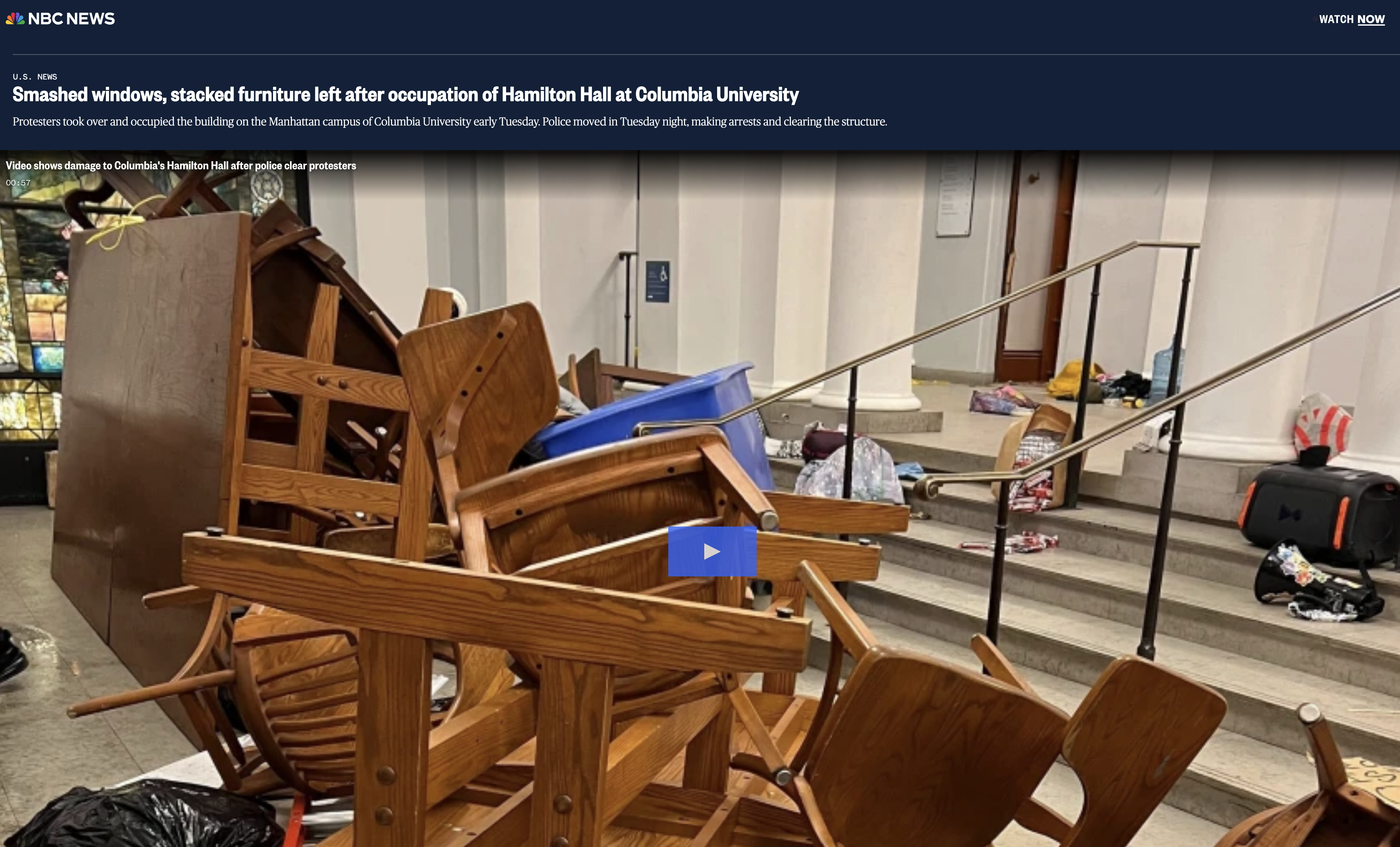
The protesters illegally occupied buildings, trapped maintenance workers who remained unprotected by the university until police arrived, and injured a security guard, but never faced prosecution.
There is significant proof of these illegal activities. Many Americans witnessed the most physically violent acts on live TV, but the crimes have been left out of some of the loudest conversations.
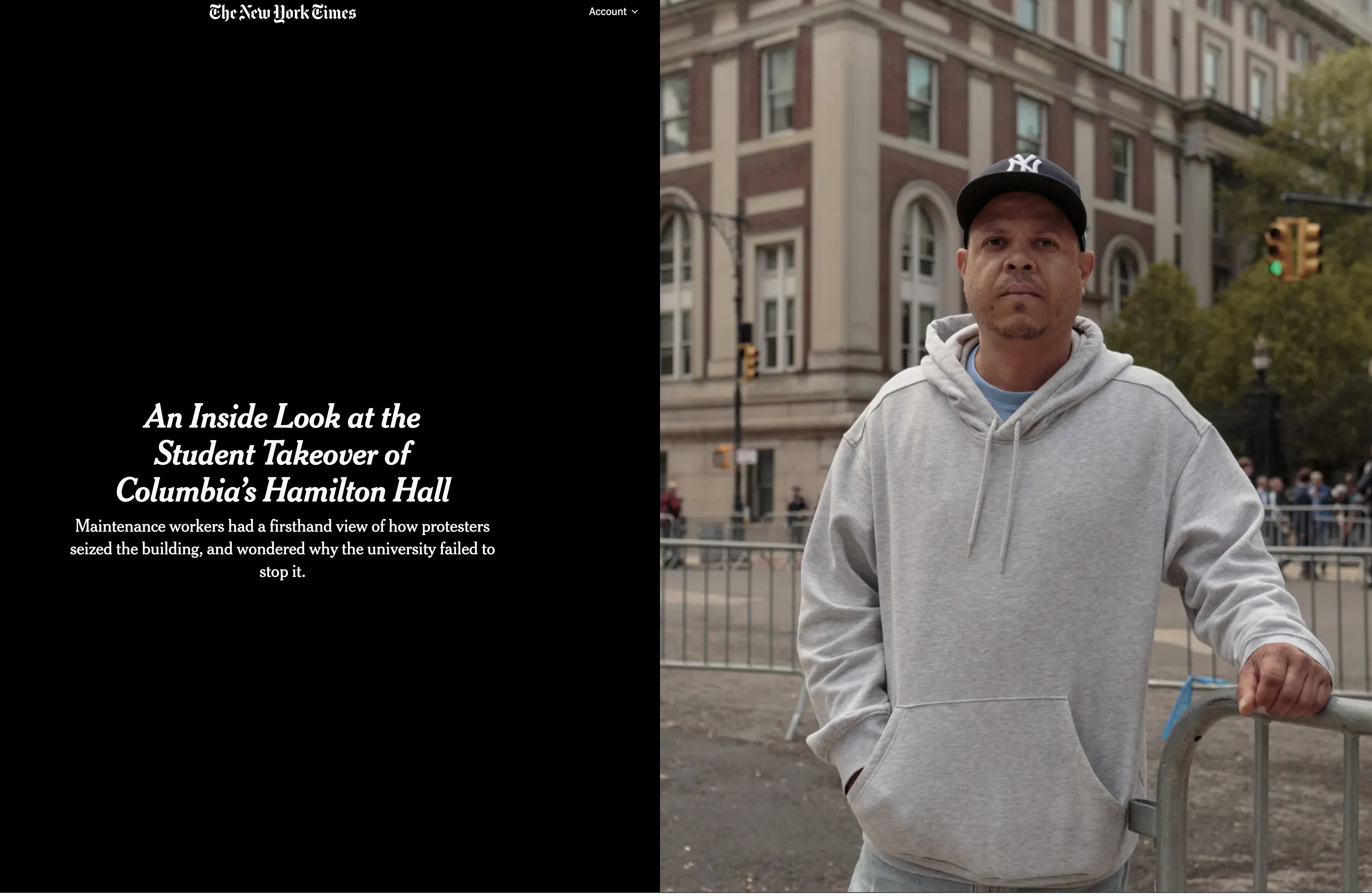
Unfortunately, supporters of Khalil and some of the media are ignoring multiple miscarriages of justice since the fall of 2023 in their protest of possible First Amendment violations. The defense of Khalil was originally and rightfully about due process. ICE was initially unable to point to the correct mechanism to detain him. It quickly morphed into a refusal by some of the resistance to examine his speech and how it related to larger illegal activity on the Columbia-Barnard campuses. (It should be noted that had these problems occurred at a public institution, some of the illegal activity could be considered a First Amendment violation of religious freedom based on the Free Exercise clause.)
As we wait for the government’s evidence for the Khalil deportation hearings, the gap is notable between those who remember the crimes that occurred on the Columbia-Barnard campuses and those who have forgotten them in defense of free speech.
It not only reflects the polarization in American society today, but also points to something unhealthy about American politics and culture long before Trump took office. The focus on the repugnancy of free speech as a diagnostic test for our democracy, whether through conviction or for the sake of political strategy, requires that the body politic deny yet again the consequences they’ve witnessed for the sake of high ideals: open violations of Title VI, occupation of buildings, endangerment of staff, and injury to personnel. We only have to look at the political advertisement ‘Kamala is for they/them. President Trump is for you’ for a concrete example of what happens when lofty goals are not backed up by the here and now. The Democrats, who were in power at the time, never enforced measures that would guarantee the safety of every minority on campus, while the American public watched and witnessed. The left never followed through with equal protection for all.
“What convinces masses are not facts, and not even invented facts, but only the consistency of the system of which they are presumably part.” — Hannah Arendt, The Origins of Totalitarianism
It is very easy for the Trump administration to exploit this hypocrisy, and it has already done so in its letter to Columbia, which can be downloaded at the end of this essay. The demands for remedying Title VI violations are reasonable. Whatever the extrajudicial actions taken in general immigration matters, the current administration’s undermining of rule of law is easily masked by the left’s creation of Khalil as a poster boy. The question moving forward is whether the government can prove a link between Khalil’s speech and terrorism, and if illegal activity at Columbia will play a role.
The ramifications of this case and the conversation surrounding it are too complicated for me to address in this essay alone. Essays to follow will examine:
- The gap between our legal understanding of the consequences of speech and interpretations of hate speech from other fields.
- Why the current “imminent danger” test for linking speech to action makes demonstrating this legal connection difficult.
- Whether the potential miscarriage of justice resulting from the “imminent danger” test undermines faith in American democracy to protect civil rights.
- Why the age-old “Jewish question” is part and parcel of today’s American political climate, rather than a topic to be avoided because it seems irrelevant or divisive.
Below this divider line is the letter from the Trump administration to Columbia.
Barnard College began as the women’s division of Columbia University and retained its independence when Columbia began admitting women in the early 1980s. There is cross registration between the schools, and facilities are shared. Barnard ladder faculty are reviewed by the corresponding Columbia department for tenure. ↩