The Relationship Between Jews and the Nation-State: Hannah Arendt’s Analysis of Emancipation and Antisemitism Conversation 1.2
What Hannah Arendt Can Teach Us Now: An Elephant in the Room Series

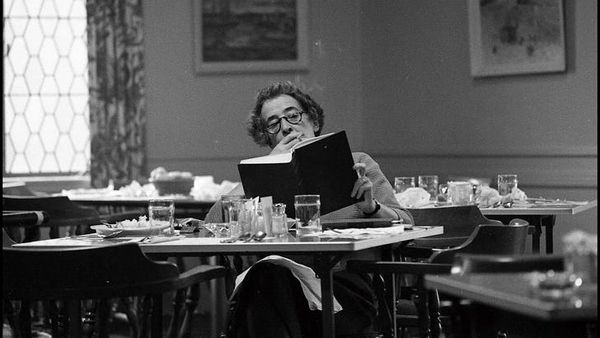
In our first discussion about Hannah Arendt, we paid special attention to her focus on antisemitism as front-and-center in The Origins of Totalitarianism. It was no accident that Arendt included antisemitism in her analysis of the rise of this new political system. Arendt was born in 1906 to a secular German-Jewish family. In 1933, when the Nazis came to power, she was detained briefly by the Gestapo for researching antisemitism in the Prussian State Library. She quickly escaped to Czechoslovakia through the “green border,” the forested areas along state lines that weren’t as easily patrolled by the authorities.
By the time she began writing The Origins of Totalitarianism in the late 1940s, she had been an eyewitness to much of the political and military turmoil on the continent, including escaping an internment camp after being detained as an “enemy alien” in France. She immigrated to the United States in 1941, but remained stateless for many years. She received American citizenship in 1950. The Origins of Totalitarianism reflects not just her doctoral training in philosophy, but also her eyewitness observations of the final collapse of the feudal order after the Great War. The book is as much historical interpretation as political theory.
It’s the relationship of Jews to the end of the feudal order and the rise of the nation-state that we will discuss in this second conversation.
If you are just joining this series, please read the introduction, as well as the explanation of how this series is structured and why it is different from opinion essays. Otherwise, skip below the next divider line.
Keep the following in mind as you read through these conversations: The first half is for the casual reader. In the middle, I provide questions and quotes for consideration. The second half is meant for those who want a deeper dive into the material. At the very bottom, I provide a bonus question for everyone.
Conversations like this rely on civil discourse that remains on topic. Please keep this in mind as we engage in discussion. If you prefer anonymity, but want to comment, send me a DM. Please exercise discretion if you choose this option.
In our last conversation, I presented two quotes that introduced some of Arendt’s thoughts about the dynamics of European antisemitism. Her primary analytical points focused on how Jews fit into a Christian society, particularly in terms of the professions open to Jews under a morphing, then dying feudal system. I asked the following questions previously:
- Why might Jews not be politically engaged?
- Why does Hannah Arendt focus on the state in these quotes?
Until the Enlightenment period of the 18th century, a small cohort of court Jews played the role of international, financial mediaries as Christianity had strict limitations on lending practices during the Medieval period. They enjoyed privileges and protections that the average European Jew did not, and they did not necessarily maintain relationships or a sense of belonging with the average Jew. Nevertheless, according to Arendt, the court Jews still played somewhat of a representative role in that the entire population could still be afforded protection by those in power and those who served power.
As the political system was transitioning out of absolute monarchy and mercantilism, this relationship was altered. The era of court Jews serving one master was over. The rise of nation-states that served citizens, not subjects, had different administrative and financial requirements for domestic matters and foreign wars. This change rendered court Jews obsolete. They were no longer needed as international mediaries and financial brokers. The banking powerhouse of the Rothschild family that arose during the late 18th century lent its capital where it saw fit. It was no longer attached to a specific political entity.
Arendt highlights some consequences of this history: 1) Jews become unimportant to the functioning of the state, especially as jobs and professions, not estates (nobility, clergy, peasantry), begin to define the relationship between government and subjects. This leaves the Jewish population generally unprotected 2) Most Jews rarely concerned themselves with politics because they could have no hope of influence. 3) As the rising bourgeoisie focused on the exchange of money detached from politics, Jews who entered this class in the late 19th and early 20th century were even less engaged with politics and therefore could not see the danger as old forms of Jew-hatred morphed into the political tool of antisemitism.
At the center of Arendt’s analysis of antisemitism, therefore, is not just the relationship between Jew and Gentile, but also how Jews of different social standing relate to each other. Outgroups are not just a matter of the relationship between governments and the people they govern. They also create their own internal hierarchies and animosities that leave them more vulnerable to organized discrimination and violence. For European Jews, having what we would call today a hyphenated identity afforded little protection at a time when states were coalescing around ethnicity. As national identity became attached to racial hierarchy in the 19th century, the danger grew.
In our last conversation, I asked what the difference is between social discrimination and political argument. Keep considering this question as we move into today’s quotes and comment below if you wish.
Today’s quotes focus on Arendt’s exploration of the Dreyfus Affair. They are designed to get us thinking about how Arendt draws from historical events to make greater generalizations about political systems. This is also an opportunity to start making comparisons to the role American Jews are playing in US politics, as well as how American Jews are being portrayed by their fellow citizens.
Alfred Dreyfus was a captain in the French Army. He was the son of an industrial bourgeois family and graduated from the elite École Polytechnique. Today, he might be considered an Ivy League-educated member of the professional-managerial classes. In 1894, he was accused of passing military secrets to Germany. Rather than confronting the culpability of a well-connected aristocrat — Major Ferdinand Walsin Esterhazy — the conservative, Catholic-aligned high command used Dreyfus’s Jewish ethnicity to divert attention from institutional failure and shield its own privileges. In turn, these elites obscured class divisions by framing the case as a defense of national honor and in doing so conflated Jewish identity with disloyalty to reinforce social hierarchies. In 1898, novelist and journalist Émile Zola published “J’accuse…!” (‘I Accuse’), shattering this alliance of class and ethnic prejudice and forcing a retrial that exposed fabricated evidence and secured Dreyfus’s exoneration in 1906.
Consider the following quotes from Arendt's examination of the Dreyfus Affair:
- What can be said or not said by public officials?
- How do Dreyfus’s educational background, career, and ethnicity play a role?
“Those members of Parliament who had learned to regard politics as professional representation of vested interests were naturally anxious to preserve that state of affairs upon which their calling and their profits depended. The Dreyfus case revealed, moreover, that the people likewise wanted their representatives to look after their own special interests rather than to function as statesmen. It was distinctly unwise to mention the case in election propaganda” (151).
“[Georges] Clemenceau [Former Prime Minister of the Third Republic] was one of the few true friends modern Jewry has known just because he recognized and proclaimed that Jews were one of the oppressed peoples of Europe. The antisemite tends to see in the Jewish parvenu an upstart pariah; consequently in every huckster he fears a Rothschild and in every shnorrer a parvenu. But Clemenceau, in his consuming passion for justice, still saw the Rothschilds as members of a downtrodden people” (154).
“The case of the unfortunate Captain Dreyfus had shown the world that in every Jewish nobleman and multimillionaire there still remained something of the old-time pariah, who has no country, for whom human rights do not exist, and whom society would gladly exclude from its privileges. No one, however, found it more difficult to grasp this fact than the emancipated Jews themselves” (153).
This section is for those who want a deeper dive into the above quotes.
In our last conversation, I asked what “canary in the coal mine” means in the context of political theory. While “canary in the coal mine” is often used as a catchphrase to draw people’s attention to burgeoning political turmoil, Arendt’s analysis deepens its meaning by examining systems.
In today’s conversation, the quotes from Origins highlight prejudices against Jews that can be used as political tools. Using these quotes, consider the following:
- What indicates cracks in national identity, economic systems, and class dynamics?
- Can Jews be full citizens under these conditions?
- Compare the cracks in late 19th-century political systems to the latest explosion of antisemitism and political tensions today.
BONUS QUESTION:
Last week, I asked how Arendt would evaluate Holocaust education today. I’m going to let us stay with this question a little longer before I offer some thoughts.
For today’s bonus question, I’m using American popular culture to get us thinking about the position of Jews in American society. The following clips are from South Park. The first is from the 1999 movie, South Park: Bigger, Longer & Uncut. In it, Sheila Broflovski instigates war against Canada. The second is from “It’s a Jersey Thing” (Season 14, Episode 9), where Kyle learns the family is originally from Newark, NJ. Sheila is portrayed as the stereotypical NY-Metropolitan area Jewish mother.
Why does South Park make Sheila the one who foments an offensive strike on Canada?