A Critique of Gandhi's 1938 Essay "The Jews"
What Hannah Arendt Can Teach Us Now: An Elephant in the Room Series
Today’s guest essay is from Patricia Munro, a scholar of Jewish Studies and a sociologist. Her Ph.D. dissertation became the book Coming of Age in Jewish America: Bar and Bat Mitzvah Reinterpreted (RUP 2016). The book uses Bar/Bat Mitzvah as an example of relationships among rituals, institutions, and participants—in effect, a study of how individuals and communities negotiate shared rituals. Her Master’s thesis looked at the Jews of Hellenistic Egypt. From 2018-2022, she served on the Livermore City Council, which gave her another view into how individuals and communities interact. For more, see her work at the Substack Question Assumptions.
Introduction
This essay began with a casual comment on R. T. Greenwald’s Substack essay, “Authoritarianism and Its Antidote: Arendt Meets Gandhi in the Age of Trumpian Narcissism.”1 The essay is a meditation on Arendt’s work on authoritarianism, how Satyagraha—Gandhi’s philosophy of active nonviolent resistance—was used successfully both in achieving Indian independence and advancing civil rights in the United States, and how similar active nonviolent resistance might be used to fight current rising authoritarianism in the US.2 My comment simply noted that the situation that European Jews faced in the first half of the 1920s and 1930s challenged the universality of Satyagraha. Greenwald was kind enough to invite me to expand my off-the-cuff comment into an essay, and I am grateful for the opportunity to think and write more deeply on the subject.
My knowledge of Jewish history and thought, my study of and research on the sociology of religion and American Judaism, and my experience in trying to effect real change in local governments all lead me away from placing ideology and philosophy ahead of what pragmatically enables people to thrive within communities and as individuals. It is from that perspective that this essay is written.
Gandhi, Satyagraha, and Me
My knowledge of Gandhi and Satyagraha came from living through the 1960s US Civil Rights movement and studying 20th-century history. Films of the Salt Marches and of Selma intertwined in my imagination. Gandhi was the hero who showed—through his words and actions—how nonviolence could be used to liberate a people from tyranny.
I was not alone in my admiration: Satyagraha has remained one of the 20th century’s most influential political ideologies of resistance to power and oppression. Indian Independence, the US Civil Rights, and current anti-authoritarian protests in the US are arguments for Satyagraha as a tactic against oppression. It is not, however, a universal approach to oppression.
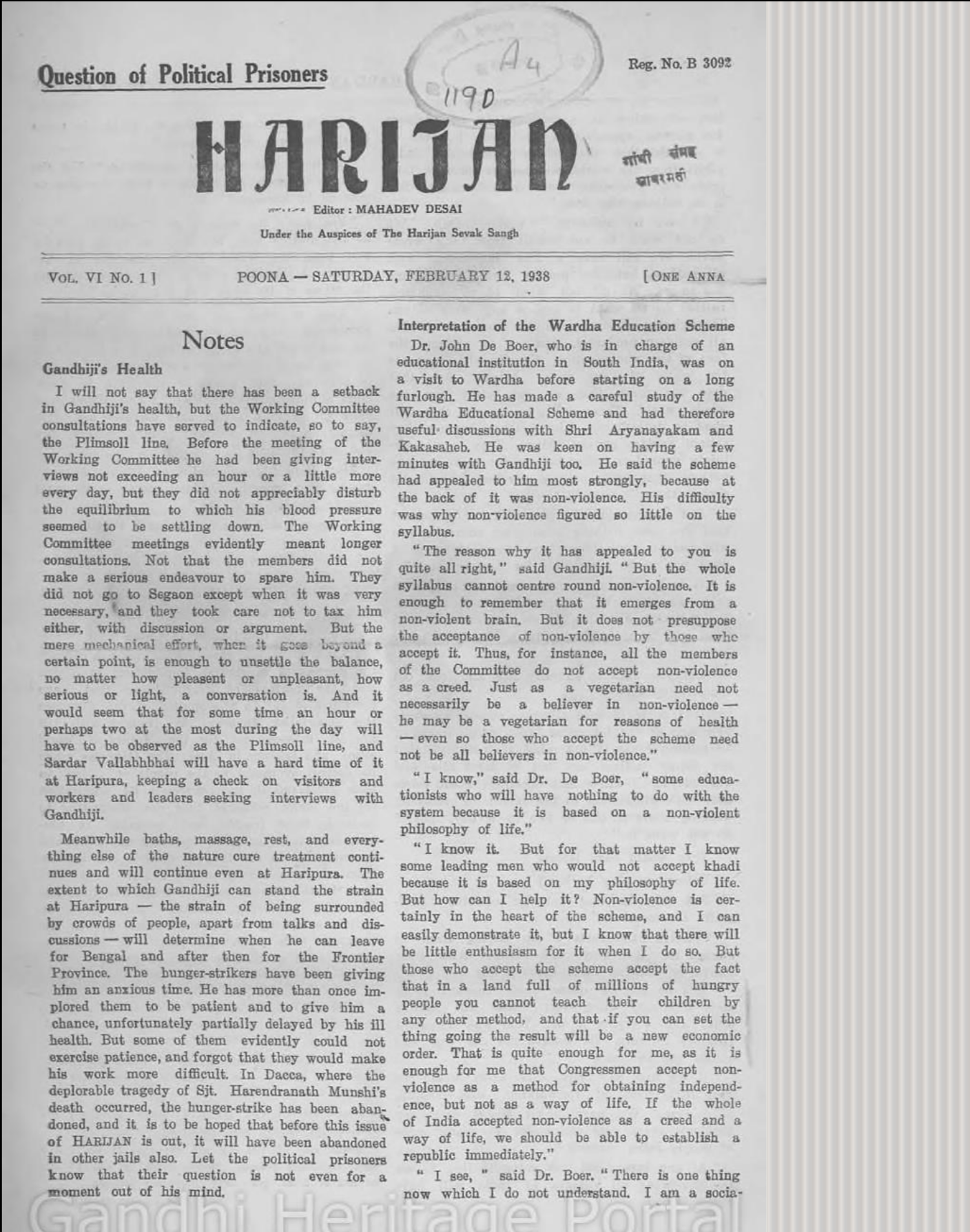
In 1938, two days after Reichskristallnacht, Gandhi published a well-known essay, “The Jews” (Harijan, November 11, 1938),3 in which he argues against Zionism and for Jews simply applying the principles of Satyagraha to their plight in Germany. The essay has been justified, critiqued, and analyzed ever since it was published. When I read it initially, it showed me a man who so needed to universalize his beliefs that he was willing to sacrifice real people—my people—for his ideology. It was painful to read and I simply turned my back on Gandhi.
Satyagraha and its Uses
Satyagraha, literally “truth-force,” is a form of active nonviolent resistance, based on love for all and rational persuasion. It demands that its followers use great discipline to resist the violent words and actions of those in power, yet hold firm while engaging in civil and nonviolent resistance. Sometimes that resistance simply gives courage to participants. Sometimes they influence others and even convert them to the cause. Sometimes they even change the hearts and minds of the oppressors themselves.
Satyagraha emerged from a specific context—British colonialism in India,4 — and was developed by a particular person—Gandhi, with a specific intent—to liberate India from British colonial rule. Both the national and the personal context matter for determining how or if Satyagraha is the right approach in other situations.
Gandhi imagines that he developed Satyagraha out of Hinduism and Indian history and, in large part, that is the case. Nevertheless, he grew up under British colonial rule, studied law in London, and developed his political activism in apartheid South Africa. Either deliberately or unconsciously, Gandhi developed Satyagraha in way that was congruent with Christian language and theology. Its focus on love above all and on a firm nonviolence, similar to “turn the other cheek,” aligns well with Christian texts and theology. Beyond that, Gandhi’s tragic murder turned him into a Christ figure, making his words all the more powerful both for Indians and for the British. By implicitly invoking Christian theology, Satyagraha became more accessible to non-Hindus—that is, the Anglican British—increasing the likelihood of winning over (some of) the British.5
There is evidence—particularly in the famous 240 mile Salt March in 1930, that Satyagraha was successful: it acted both to unite the different Indian factions and demoralize the British. Nevertheless, I wonder if it simply hastened the inevitable.
Unlike China, with its long history of relative unity under different dynasties, India’s history was fractious, similar to the warring feudal states of Britain and Europe during the Middle Ages. While that made India easier for the British to conquer, it also made the country difficult to control.
Gandhi entered the political scene at a turbulent time in Europe. European countries, including Britain, were dealing with the devastation of WWI, which had destroyed a generation of young men. The world was suffering through the Great Depression. Nationalism and a rejection of colonialism were on the rise across the world, particularly in the Middle East.
While Satyagraha was a tool that could and did unite all Indians, regardless of which faction or state they allied with, against the British, it may be that the British were not exactly eager to remain.
India became independent in 1947.6 The aftermath of the British departure was anything but nonviolent. Despite Gandhi’s best efforts, Muslim and Hindu extremists divided neighbors from each other, ultimately leading to the two states of Pakistan and India, created by the displacement of between 12 and 20 million people and the deaths of between several hundred thousand and two million people.3 Satyagraha was able to unite India against the British, yet that unity was not sufficient to overcome the religious differences stoked into hatred by extremists, one of whom murdered Gandhi.
We human beings create our social structures, relationships, and realities out of our imaginations and shared agreements. That begins early—just watch a group of children build an imagined universe together. But these social worlds can and do conflict—there is no one ideological panacea that leads to utopia. Even within the struggle for Indian Independence, Satyagraha was effective in achieving that independence, not so much in reconciling groups unwilling to compromise.
And yet, Gandhi was so convinced of its universality, that he wished to impose it on the Jews. The differences between the Indian and the Jewish peoples, history, and context could not have been more different.
Exodus and Exile, Stability and Reclamation
Jews can be defined as a joinable people, who share a common history, homeland, culture, language, calendar, and religion. Judaism is the non-universalizing religion of the Jews. There are 15 million Jews--.02% of the world’s population. While the land of Israel is central to Jewish narratives, prayers, and holidays, the Jewish people itself has been landless throughout most of Jewish history. In addition, for 2000 years the Jewish people have stood in symbolic opposition to the supersessionist religions of Christianity and Islam. The result is that, through the centuries, Jews have lived a vulnerable, fragile existence, in which anti-Jewish hate in its many forms could and did easily rise.
On the other hand, there are a billion and half Indians, about 80% of whom are Hindu, with a large land they have continuously occupied and mostly ruled—albeit fractiously—for millennia. Hinduism is deeply rooted in that settled history, with one sacred narrative layered atop the next. The result is a very large people, secure in their land, despite the two centuries of British oppression and colonization.
Despite the vast differences in size, rootedness, and history, Judaism and Hinduism do share some deep commonalities. Each has its own common history, homeland, culture, language, calendar, and religion. Neither is a universalizing religion, but a way of life for a people, a way of life that could be—but didn’t have to be—shared with others. Yet the radically different sizes of the two populations, their different relationships to their two homelands, and the way they have been conceived by the world makes for very different survival strategies.
In addition, their two approaches to free will, choice, and relationship to how to live in the world differ. The central narrative of Judaism is the Exodus, which tells how the children of Jacob/Israel became the Jewish people with their own rulebook, history, land, and destiny. It is one story of liberation, the creation story of a people.7 The story begins with a small population oppressed in a land not their own, a population that leaves that land for another, learns to be free, and is given a guidebook (Torah) for how to have a thriving society.
The Exodus, as sacred myth, is the guide for what Jews believe and how they act as living, breathing people. The Hindu sacred myths, in contrast, lead Hindus to focus on perfection of self over lifetimes of rebirth. While both religions are practice-driven, the kind of practice and the relationship to action in this world are different.
As Gandhi developed Satyagraha, he had to balance the active non-violence of Satyagraha with a worldview of karmic retribution through rebirth. In fact, it is surprising that, given Hinduism’s respect for other religions, Gandhi would choose to impose the principles of Satyagraha on another people, particularly one about which he apparently knows little. And yet that is what he does in The Jews. It is to that essay that I turn next.
A Jewish critique of Gandhi’s The Jews in six quotes
Rereading The Jews in light of the past two years of war between Hamas and Israel and the subsequent steep rise in anti-Jewish hate and violence has been painful. It shows no real understanding of Judaism, Jews, or Jewish history—quite the reverse, in fact, something deeply puzzling, given Gandhi’s claims of sympathy toward the Jews. And yet, his words speak for themselves:
- “I have known [Jews] intimately in South Africa…Through these friends I came to learn much of their age long persecution.”
There is a great difference between friendly conversation among friends and research into a topic. “Some of my best friends are Jewish” is a very poor argument for anyone, let alone a lawyer. - “They have been the untouchables of Christianity. The parallel between their treatment by Christians and the treatment of untouchables by Hindus is very close.”
No. Simply no. Jews are not in any way part of Christianity, as both Christians and Jews agree. The fact that Jews, as a people and theologically, rejected Christianity is the basis for anti-Judaism, for the rise of the libels against Jews, and for the Jews becoming a pariah people. While the Hindu “untouchables”—Dalit caste—were and perhaps still are the pariahs of the Hindu people and religion, they were pariahs within a common religion. Whether intended or not, Gandhi has—as so many others have—turned the real Jewish people something imaginary, yet convenient for his own use. - “The cry for the national home for the Jews does not make much appeal to me. The sanction for it is sought in the Bible and the tenacity with which the Jews have hankered after return to Palestine. Why should they not, like other peoples of the earth, make that country their home where they are born and where they earn their livelihood?”
Encoded in this paragraph is one of the classic libels: Jewish greed. Unlike other peoples, who are content with one land, Jews want two. How dare they? Except, of course, that wasn’t primarily what Zionism was about, especially in the mid-1930s. Rather, it arose primarily as a response to the “Jewish problem,” in which Jews were unwelcome in every country. My own grandparents and great-grandparents, like over a million other Jews, fled the Eastern European pogroms. They were never Russians; they were Jews who lived in Russia. In France, Alfred Dreyfus was famously and falsely convicted of treason because he was Jewish. His trial was supposedly the catalyst for Theodor Herzl’s Zionism—a single place where Jews could live as other peoples did. Gandhi complains that the Jews want two countries; he would deny them even one. - “Surely it would be a crime against humanity to reduce the proud Arabs so that Palestine can be restored to the Jews partly or wholly as their national home.”
Here, Gandhi is creating a romantic vision of an imagined Arab from the complicated reality of the warring regional factions, the consequences of the fall of the Ottoman Empire, the impact of British colonialism, and the ways in which Jews acquired land—through purchase. In so doing, he is using tropes that have been amplified today: Israel’s existence as a “crime against humanity,” the “proud [good] Arab,” and the implied Jew as colonizer. It is an odd stew of European antisemitism and resistance to colonialism, with the Jews as stand-ins for the British. - “The nobler course would be to insist on a just treatment of the Jews wherever they are born and bred…Let the Jews who claim to be the chosen race prove their title by choosing the way of non-violence for vindicating their position on earth.”
Because that approach had worked out so well for Jews in the past, as different forms of anti-Jewish hate rose and fell throughout the millennia—into the present day. The casual dismissal of that history is beyond offensive. - “The Jews of Germany can offer Satyagraha under infinitely better auspices than the Indians of South Africa. The Jews are a compact, homogeneous community in Germany. They are far more gifted than the Indians of South Africa. And they have organized world opinion behind them. I am convinced that, if someone with courage and vision can arise among them to lead them in non-violent action, the winter of their despair can in the twinkling of an eye be turned into the summer of hope.”Gandhi published The Jews in 1938, two days after the Kristallnacht pogrom and a few months after the Evian Conference at which the attending nations refused to take in German Jewish refugees, leaving them to the German death camps. In order for Satyagraha to be effective, the other parties have to care, have to see the humanity in the other. No matter how much Gandhi would have wished otherwise, the world gave not a damn.
The Lessons of History
The protests against rising authoritarianism in the US use many of the Satyagrahan techniques. They are attended by millions and are, without exception, peaceful yet forceful. They are powerful ways to build solidarity and claim the moral high ground. Those protests are precisely the kind of movement for which Satyagraha works and works well.
Yet I cannot read about Satyagraha as an ideology without seeing the images of bloody and mutilated Jewish bodies lying in the desert sun after October 7, 2023, crematoriums pumping the ashes of Jewish bodies onto snow in the 1940s, and my young grandfather hiding from the Cossacks, hearing the gunshot of Cossacks as they murdered his grandfather in 1910. There is no place in that history for an effective use of Satyagraha.
By choosing not to engage with Jewish history, Gandhi placed Satyagraha above the lives of real people. Intended or not, it was an act of arrogance and cruelty. The reality is that Satyagraha is one of many tools used to effect societal change. Determining its limits is part of responsible political action.
https://rtgreenwald.substack.com/p/authoritarianism-and-its-antidote ↩
In fact, this has taken place already: the principles and practices of Satyagraha are an assumed part of the instructions to people planning to show up to protest marches, from the 2017 Women’s March to the most recent 2025 No Kings March. That these protests have been almost entirely peaceful and have grown over time illustrates the successful use of the practice. ↩
The full essay can be found here: https://www.jewishvirtuallibrary.org/lsquo-the-jews-rsquo-by-gandhi or here: https://www.mkgandhi.org/mynonviolence/chap27.php ↩
Gandhi developed it in South Africa, but I would argue that context was a “beta-test” for India. ↩
In much the same way, MLK, Jr. used the common Christian tropes to connect those wanting to fight racism. On a related note, Elie Weisel’s Night, as published for the world, is very different from the raw anger at the Chrisitan world that enabled the Shoah that appears in the original Yiddish version. ↩
The difficult histories of Bangladesh and Kashmir further complicate the story. ↩
To be very clear: the Exodus story is the founding narrative of the Jewish people. Its historicity—or not—is not the point. ↩