Awe, Adoration, and Ear Bandages: Inside the Psychological Dynamics of Authoritarian Politics
What Hannah Arendt Can Teach Us Now: An Elephant in the Room Series

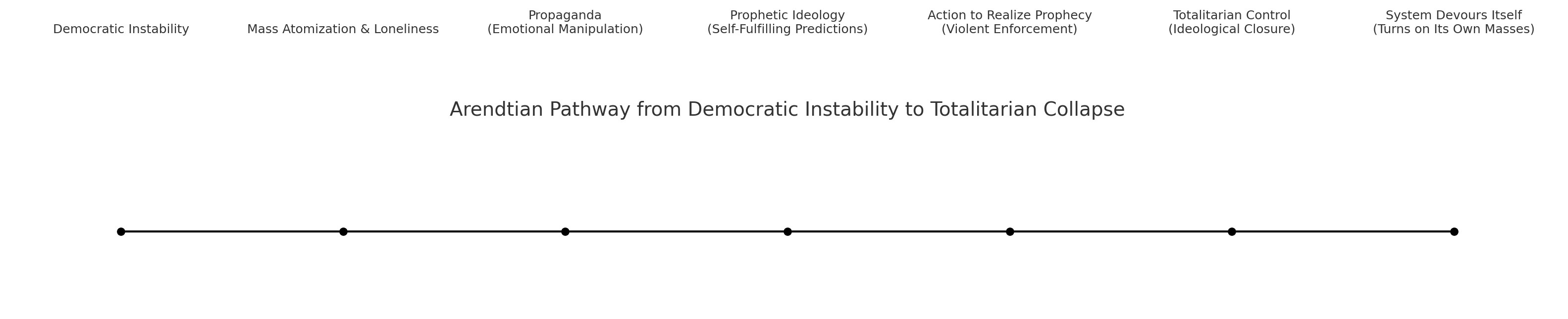
In our last conversation, I discussed Arendt’s examination of how totalitarian subjects become enthralled to a leader. The process begins with the public’s experience of gross instability and a desire for governments to keep what seems inexplicable under control. Those who don’t follow politics—“the masses”—can be particularly susceptible, since they have not developed a critical eye towards political behavior and the press. A burgeoning totalitarian regime takes advantage of this situation by first creating propaganda that identifies an enemy. This move serves the purpose of rallying and unifying the masses. Once more consolidated, leadership creates a sense of safety through fulfilled predictions that are designed to create an aura of omniscience and omnipotence. Arendt termed this system of announcement-anticipation-action “prophecy.”
Totalitarian prophecy is intended to produce a kind of awe usually associated with divine revelation in established religions. To an unsuspecting public, it can seem magical and mysterious. It is the same sense of awe that is involved in religious and personality cults.
Did we witness at the 2024 Republican National Convention the devotion that Bouguereau portrayed in “The Virgin With Angels” above? Some delegates at the convention wore bandages on their ears to mimic the dressing Donald Trump wore after the July 2024 assassination attempt. The bandage has often been portrayed as a sign of solidarity, but I see another possibility:

Some delegates helped each other apply the bandages, a tactile act of intimacy. Through collective, embodied participation, delegates transformed a personal injury into a sacred symbol of loyalty, something which reinforced belonging and psychological imprinting. The imitation, repetition, and affirmation involved convey devotion and a rite, not just a display of solidarity. It is precisely this sort of activity that prepares its participants for a religious experience.
When Arendt was writing The Origins of Totalitarianism in the 1940s and early 1950s, she didn’t have the psychological and neurological research to fully explain her observations. Nevertheless, she was well aware that she was describing a specific human behavior as she referred to “psychology” many times in her work. It’s an essential element for explaining how totalitarian regimes consolidate power. Totalitarianism is more than a political system. It is also a psychological dynamic, a large-scale death cult that brings an entire population into its orbit and eventually consumes itself.
If Arendt were writing Origins today, she might cite the wide body of literature on cultish aspects of human behavior to bolster her political observations. In the last 35 years especially, research into its physiological aspects—the nervous system, the gut-brain axis, and virology—has become wide and deep. Cults and cult-like situations can manipulate the different states of the nervous system.1 Studies strongly link the gastrointestinal system to the brain’s decoding of emotions, creating silent hypervigilance when the body detects threat.2 Viruses such as Epstein-Barr (mononucleosis) and Varicella Zoster (chick pox and shingles) remain dormant in the nervous system until the immune system is compromised by stress; once reactivated, they heighten feelings and perceptions and may be responsible for some of the severest psychiatric symptoms.3
I will go into all of these factors in the coming weeks. It’s important to understand how the interplay of these soma can both create a manipulative leader and capture an audience to the point of destroying the moral compass. Many loyal supporters of Donald Trump, as well as friends and acquaintances of Jeffrey Epstein, have become so enthralled that they can’t tell the difference between right and wrong. Some prefer to rationalize and explain away sex with underage girls rather than confront the repugnancy and depravity of the men they idolize. Others, like those who subscribe to QAnon, recognize and abhor the pedophilia at the center of their conspiracy theories, but are unable to see the culprits right in front of them. Instead, they project their instincts about child sex trafficking onto ethnic and gendered strawmen: the Italian-American gay-owned pizza joint, the blood libel attached to the Jews, the virago presidential candidate. Perhaps it’s not surprising then that QAnon, in a messianic turn, managed to link one of America’s most iconic and dynamic families, the Kennedys, to a coming second term of Trump.
These projections are classic manifestations of a dynamic that links fear to identity and group dynamics. They are also the same factors that produce better and worse opposition strategies to counter the propaganda and prophecy dynamic (see “Arendt, Iran, and the Seduction of Certainty” for an illustration of how the opposition plays into authoritarian consolidation). But before I dive into the physiology of our current political situation, I want to focus first on clinical psychology, the observational framework that ties all of the above together. Clinical psychology describes well how someone becomes an exceptional manipulator. It also explains how personal and social dynamics allow this manipulation to play out at the expense of the body politic and the general health of the individuals or society involved. Arendt herself became an amateur clinical psychologist in The Origins of Totalitarianism to explain and portray what brings populations to throw their fate behind nihilism.
To this end, I have asked Dr. Simon Rogoff for permission to reprint some of his Substack essays on narcissism to better understand the dynamics within and between the Trump administration and the MAGA movement. Dr. Rogoff is the author of the Substack column “Narcissism, Trauma and Celebrity,” in which he explores the rich and famous through the lens of narcissism theory. Outside of his Substack work, he leads a treatment service for the National Health Service in London specifically for people with personality disorder, and has over 20 years experience with this client group. He received a doctorate in clinical psychology and a Master’s degree in forensic mental health.
I will republish Rogoff’s “The Map of narcissism” parts I and II over the next couple of weeks. I hope my readers will find this exploration timely and useful for a deeper understanding of Arendt’s analysis. I’ve also been in conversation with Dr. Rogoff about how narcissistic systems take hold and hope to share more from him in the near future.
© R.T. Greenwald, 2025. The ideas, arguments, and original frameworks presented here are the intellectual property of the author and require formal citation when referenced or adapted. For permissions, collaborations or inquiries about appropriate use, please send me a DM.
Cult leaders may hijack the Parasympathetic Nervous System (ventral vagal state)—associated with safety and social engagement—by fostering awe through prophecy and perceived power, potentially increasing suggestibility and compliance and thereby turning the PNS's natural drive for well-being towards unhealthy dependence. See Maria Naclerio and Patty Van Cappellen, “Awe, Group Cohesion, and Religious Self-Sacrifice,” The International Journal for the Psychology of Religion 32, no. 3 (2023): 256–271, https://doi.org/10.1080/10508619.2021.1975423; Hillary L. Lenfesty and Thomas J. H. Morgan, “By Reverence, Not Fear: Prestige, Religion, and Autonomic Regulation in the Evolution of Cooperation,” Frontiers in Psychology 10 (December 17, 2019): 2750, https://doi.org/10.3389/fpsyg.2019.02750; Stephen W. Porges, “Polyvagal Theory: A Science of Safety,” Frontiers in Integrative Neuroscience 16 (May 10, 2022): 871227, https://doi.org/10.3389/fnint.2022.871227; Michael Monroy and Dacher Keltner, “Awe as a Pathway to Mental and Physical Health,” Perspectives on Psychological Science 18, no. 2 (March 2023): 309–320, https://doi.org/10.1177/17456916221094856. ↩
See Emeran A. Mayer, The Mind-Gut Connection: How the Hidden Conversation within Our Bodies Impacts Our Mood, Our Choices, and Our Overall Health (New York: Harper Wave, 2018); Robert M. Sapolsky, Why Zebras Don’t Get Ulcers: The Acclaimed Guide to Stress, Stress-Related Diseases, and Coping (New York: Henry Holt, 2004); Jane A. Foster, Linda Rinaman, and John F. Cryan, “Stress & the Gut-Brain Axis: Regulation by the Microbiome,” Neurobiology of Stress 7 (2017): 124–36, https://doi.org/10.1016/j.ynstr.2017.03.001. ↩
See “Herpes Virus Link to Bipolar Disorder and Depression,” Frontiers news release, September 28, 2018, https://www.frontiersin.org/news/2018/09/28/microbiology-herpes-virus-depression-bipolar-disorder/; “Schizophrenia Linked with Abnormal Immune Response to Epstein-Barr Virus,” Johns Hopkins Medicine news release, January 9, 2019, https://www.hopkinsmedicine.org/news/newsroom/news-releases/2019/01/schizophrenia-linked-with-abnormal-immune-response-to-epstein-barr-virus. ↩