Part II Revealing Truth through Bodies: Nonviolent Coordination against Coverture's Fictions
What Hannah Arendt Can Teach Us Now: A Draw to Judgment Series--**Academic Essay Edition**
This essay is continued from Revealing Truth through Bodies Part I, January 29, 2026.
LIBERIA in 2003
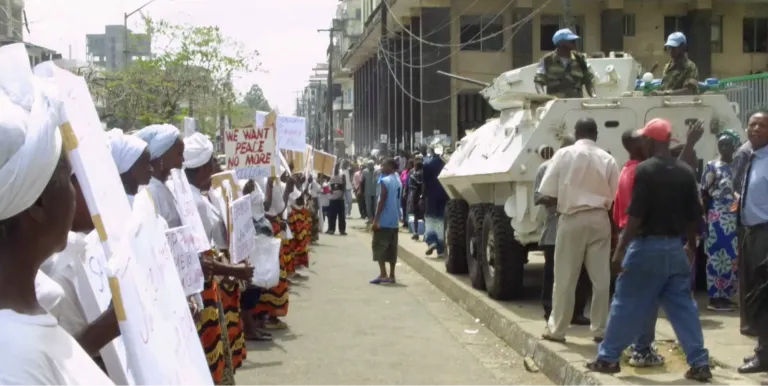
From April through August 2003, Liberian women led nonviolent protest actions that were the turning point for ending the country’s 14-year civil war. The protests included prayer, blockades, rallies, and mass demonstrations. Most notably, Liberian women also utilized body-specific refusals and actions. Like Icelandic women, Liberian women were no longer under legal coverture. The 1986 constitution guaranteed that all persons were equal before the law and would receive equal protection under the law. Nevertheless, Liberia’s dual legal system placed customary law on the same level as national rights. In rural areas, in particular, customary law treated married women as minors with little independence or property rights.1 The civil war heightened these conditions as women were dispossessed and excluded from inheritance.
Years of sexual assaults, torture, and harassment by soldiers, as well as abductions where women were forced into labor and into marrying the armed combatants, brought women to reclaim agency as harsh conditions were slowly becoming annihilation. Over the course of just four months in 2003, Liberian women turned themselves into a significant political force. Their chosen nonviolent methods brought male citizens to reconceptualize the violation of women not as a sex-specific form of domination, but as a transgression of human dignity. Liberian men, in the face of this revelation, broke ranks from the dominant authoritarian-narcissistic system and switched allegiances to the subjugated party. With the dominance system broken, the government and rebel warlords were forced to the negotiation table.
The nonviolent protest movement began when Leymah Gbowee, the eventual leader of Women of Liberia Mass Action for Peace (WLMAP), organized women from her church to protest the war. Gbowee and many other women faced extraordinary violence to their bodies for years and were barely surviving. Those who escaped after being abducted were now caring for their remaining children under terrible conditions. Many also witnessed their husbands and children conscripted or murdered. WLMAP started as a small prayer group of Christian women. Word spread eventually to Muslim women.2 Since “bullets don’t pick and choose between Christian and Muslim Women,” the two groups put down their cultural and religious differences and worked together.3
Safety was at the top of the agenda in this resistance movement. WLMAP trained in nonviolent coordination for several months. Their first action, which defied President Taylor’s ban on marches, was staged in April 2003. To create a unified front–important in reducing the isolating tactics of authoritarianism–WLMAP passed out white shirts for the women to wear and requested that they not wear makeup.4 This request is significant. The application of makeup is a performance that alters appearances for a particular effect. Within the narcissistic-authoritarian dynamic in particular, the pressure to wear makeup ensures conformity both in the look and the labor required to achieve the desired appearance. Requesting that women not wear makeup was a strategic way to ensure that women’s public appearance remained unmediated and undistortable.
Twenty-five hundred women showed up for the first protest at Monrovia’s fish market. Eventually, their actions caught the attention of the speaker of parliament and President Taylor. With greater attention from the top levels of government, the women decided to stage an even more daring and disruptive action, one that focused attention on men as the specific perpetrators of violence. They staged a sex refusal whereby women withheld sexual relations with their partners until the war was ended.5 Gbowee “said to the women that one way or the other you have power as a woman, and that power is to deny your man sex … and ask him to do anything in his power to put a stop to the war.”6
Safety, again, was at the forefront. WLMAP created spaces where women could sleep as a group so that their husbands couldn’t rape them during the refusal. The action communicated that women controlled access to their bodies, not men, and that they would organize as a collective to prevent further violations. According to Gbowee, many men began to pray with their wives–an immediate switch of allegiance that demonstrated the power of the women to protect themselves and maintain their integrity.7 Was this a practical move born of physical needs and self-conception or did the men understand the larger significance of aligning with the women? This discreet question remains unanswered from the sources I examined. Nevertheless, this switching of allegiance raises a broader question about the nature of male camaraderie and female exclusion: is male bonding at the expense of half the population evolutionarily adaptive or is it coerced by the threat of narcissistic reprisal?
The sex refusal also served the dual purpose of generating international attention. Revelation of truth requires a witness–whether it is the western world recognizing British brutality in India or American citizens forced to reckon with their own brutality during the Civil Rights era.8 Eventually, the international community played an important role in monitoring the peace process and maintaining order in the region.
Witnessing, however, requires first that truth be revealed—in this case, the falsehood that male violence is evolutionarily commonplace and expected. At the final peace negotiations in Ghana, the women demonstrated that their ancestral and mediating authority superseded the demands of American-introduced coverture. Around mid-June 2003, they stormed the building where the talks were taking place. This was a direct assertion of power in the face of crumbling peace talks and fighting starting up again in Monrovia. Approximately two weeks before, Charles Taylor was indicted for war crimes by the UN-Special Court for Sierra Leone, and the resulting power vacuum likely made the parties less amenable to negotiation.9 To coerce a final settlement, the women blockaded the meeting room and back windows with their bodies. According to Gwobee they made it clear that “[n]o one will come out of this place until a peace agreement is signed.”10
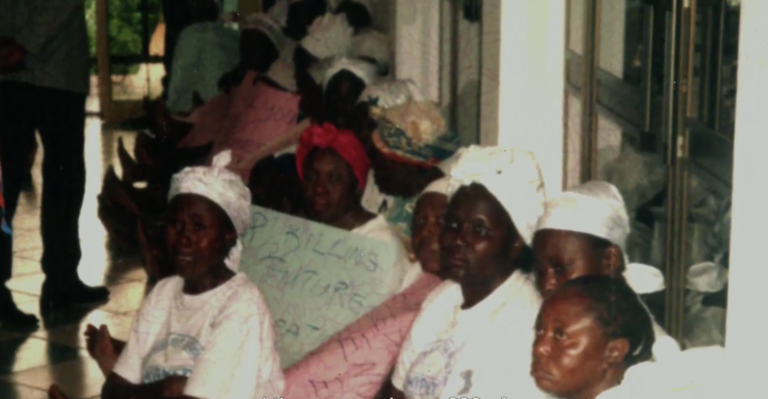
When the unarmed women faced eviction by armed security personnel, Gwobee and others threatened to strip naked, ”fully aware that in Africa it is a curse for a woman to deliberately bare herself.”11 When older women disrobe en masse in many parts of Africa, it is a deliberate public act that has nothing to do with the erotic. “Making war on a man” signals that women of the community will no longer mediate and will instead render final judgment. It is considered a curse because it removes men from the collective.12 Faced with the choice of protecting profane warlords or honoring the ancestral, moral order, the guards chose the latter, thereby instantly disintegrating the narcissistic dynamic.
What Remains of Coverture in Iceland and Liberia?
Fifty years after the women’s “day off” in Iceland, and twenty years after the civil war ended in Liberia, there are notable improvements for women in both societies. But have they eliminated the last structural and cultural remnants of coverture?
Since the Icelandic women’s “Day Off” in 1975, the nation passed the Gender Equality Act in 1976, which legally prohibited discrimination in the workplace and educational institutions. In 1980, Vigdís Finnbogadóttir became the world’s first democratically elected female head of state.13 In addition, the political landscape was fundamentally reshaped by the formation of the Kvennalistinn (Women’s Alliance), which in the 1983 election increased female representation in the Althingi from 5% to 15%. This trajectory of political inclusion continued, with female representation reaching 47.6% in the 2021 election cycle. The year 2024 brought the election of the country’s second female president, Halla Tómasdóttir, and coalition government under Prime Minister Kristrún Frostadóttir.14 In 2017, Iceland passed the world’s first mandatory Equal Pay Certification law, and in 2020, parental leave reform extended total leave to 12 months.15 Housework, however, is still not recorded as labor in government statistics and economic calculations. Iceland also faces a “Nordic Paradox,” where its top ranking in global equality indices coexists with high rates of gender-based violence and domestic abuse.16
Similar to Iceland, Liberian women’s position has improved. Ellen Johnson Sirleaf was elected as Africa’s first female in 2005. Women’s representation in the executive cabinet rose to 39% in 2025. Nevertheless, they are just 10.7% of the representatives in the national legislature today, a figure that has declined since 2006.17 The 2018 Land Rights Act formally secured women’s rights to own and inherit customary land. Economically, Liberia has achieved the highest global ranking for female labor force participation parity in 2024, with a parity rate above 95%. This figure, however, masks a structural vulnerability: 74% of all female workers are in unstable, unsalaried work situations, such as petty trade and subsistence agriculture. Nevertheless, the expansion of financial inclusion—notably through mobile money and Village Savings and Loans Associations (VSLAs)—has increased female account ownership to 46% by 2021.18 Changes in approaches to Liberian women’s issues are just as significant. When Leymah Gbowee and Ellen Johnson Sirleaf were awarded the Nobel Peace Prize in 2011, the focus on female leadership may have brought more attention to gendered power structures, rather than to governments and NGOS.
My question for readers: are economic and political opportunities for the subjugated necessary precursors for dismantling the power structures that created the subjugation in the first place or should the power structures be addressed first, then used to creating opportunities?
Circling Back to the United States 2026
To conclude this essay, I’d like to return to where we started this essay: American women refusing the Equal Rights Amendment. As Phyllis Schlafly was organizing women to maintain their own dependency status, future Supreme Court justice Ruth Bader Ginsburg was successfully arguing against the legacy of Anglo-Norman coverture. Between 1973 and 1978, the court found these laws unconstitutional in five out of six cases, rendering William Blackstone’s commentaries moot.19 In the years since, we have seen child support and alimony offered to divorcing partners of either sex, the rise of no-fault divorce, gay marriage, unisex restrooms, and women voluntarily joining the military. There are now greater numbers of women in the workforce and in public life.
Do these policy provisions and improved political participation mean that American women are no longer treated legally as minors and have adjusted their behaviors accordingly? Consider what power dynamics are revealed in the following situations. Are Americans still beholden to structural coverture?
- The right-to-life movement defines the fetus as a human being from conception, to be protected separately from the mother. Why doesn’t it address the separate material and psychological realities for the woman?
- Likewise, gender identity laws define “woman” reflexively—a woman is someone who identifies as a woman—and thereby bypass the material and psychological realities of XX and XY bodies. What does it mean to withdraw legal recognition of the physical world in favor of the solipsistic?
Bonus Question
Consider the video “Neil Degrasse Tyson & The Trans Athlete Issue” (YouTube). In it, physicist Sabine Hossenfelder offers a quantitative look at what, under other circumstances, might be considered a philosophical exercise not yet for legal consumption. What does it mean to enact an ideal into law without firm grounding in the material?
“I’m not a genius either, because if I was, I wouldn’t be talking about this.”
UNDP and Multi-Partner Trust Fund Office, Desk Review of Laws Discriminating Against Women in Liberia (Monrovia: United Nations Development Programme, 2021), https://mptf.undp.org/sites/default/files/documents/30000/desk_review_of_laws_discriminating_against_women.docx; Landesa, “Equal Rights, Equal Power: Strengthening Women’s Land Rights in Liberia,” Landesa, accessed January 28, 2026, https://www.landesa.org/equal-rights-equal-power/. ↩
Maxwell Adjei, “Ending Civil War through Nonviolent Resistance: The Women of Liberia Mass Action for Peace Movement,” Journal of International Women’s Studies, 22(9), 2021, 22-24, https://vc.bridgew.edu/jiws/vol22/iss9/2 ↩
A. Disney & G. Reticker, Pray the Devil Back to Hell (Motion Picture), (New York: Fork Films, 2008). ↩
Adjei, 22. ↩
Ibid., 24. ↩
Ibid., 24. ↩
Ibid., 24. ↩
R. T. Greenwald, “Authoritarianism and Its Antidote: Arendt Meets Gandhi in the Age of Trumpian Narcissism,” The Draw to Judgment, October 14, 2025. ↩
Adjei, 25. ↩
Ibid., 25. ↩
Ibid. ↩
Disney, Pray the Devil back to Hell; Judith Van Allen, “’Sitting on a Man’: Colonialism and the Lost Political Institutions of African Women,” Canadian Journal of African Studies 6, no. 2 (1972): 170, https://doi.org/10.2307/484197. ↩
“Vigdís Finnbogadóttir,” Wikipedia (2025), https://en.wikipedia.org/wiki/Vigd%C3%ADs_Finnbogad%C3%B3ttir. ↩
Government of Iceland, “Gender Equality in Iceland Information on Gender Equality Issues,” https://www.government.is/media/utanrikisraduneyti-media/media/mannrettindi/Gender-Equality-in-Iceland.pdf; Statistics Iceland, “Women in Parliament” (2021); Althingi. https://www.althingi.is/english/about-the-parliament/women-in-parliament-/; Statista (2021); “Share of women in the Icelandic Parliament from 1974 to 2021.” https://www.statista.com/statistics/1090585/share-of-women-in-the-icelandic-parliament/; Wikipedia, “2024 Icelandic parliamentary election,” https://en.wikipedia.org/wiki/2024_Icelandic_parliamentary_election (2024); IPU Parline, “Election results - Iceland” ((2024), https://data.ipu.org/parliament/IS/IS-LC01/election/IS-LC01-E20241130/ ↩
Kvenréttindafélag Íslands, “Looking for information about equal pay in Iceland? All about the Equal Pay Standard” (2021), https://kvenrettindafelag.is/en/looking-for-information-about-equal-pay-in-iceland-all-about-the-equal-pay-standard/ ↩
France 24, “Iceland’s dark shadow: gender-based violence in a model nation” (2025), https://www.france24.com/en/europe/20250308-iceland-dark-shadow-gender-based-violence-in-a-model-nation-women; Euronews, “Iceland’s ‘Nordic paradox’: Why the world’s best country for women struggles with sexual violence” ((2024), https://www.euronews.com/health/2024/12/07/inside-the-nordic-paradox-why-the-worlds-best-country-for-women-struggles-with-sexual-violence. ↩
United Nations in Liberia, “Legislative Caucus of the 55th Legislature Holds First Strategic Planning Retreat” (2024), https://liberia.un.org/en/268584-women%E2%80%99s-legislative-caucus-55th-legislature-holds-first-strategic-planning-retreat; World Economic Forum, Global Gender Gap Report 2024: Benchmarking gender gaps (2024), https://www.weforum.org/publications/global-gender-gap-report-2024/in-full/benchmarking-gender-gaps-2024-2e5f5cd886/ ↩
World Economic Forum, Global Gender Gap Report 2024; UN Women, Beijing+30 National Review Report: The Government of Liberia (2024), https://www.unwomen.org/sites/default/files/2024-09/b30_report_liberia_en_1.pdf; Council on Foreign Relations, Spotlight on Liberia: Growing Economies Through Gender Parity, https://www.cfr.org/womens-participation-in-global-economy/case-studies/liberia/; MFW4A - Making Finance Work for Africa, Liberia, https://www.mfw4a.org/country/liberia; Central Bank of Liberia, National Financial Inclusion Strategy 2020-2024 (2020), retrieved from https://www.cbl.org.lr/sites/default/files/documents/National%20Financial%20Inclusion%20Strategy%202020-2024.pdf ↩
“Ruth Bader Ginsburg.” Oyez. Accessed January 22, 2026. https://www.oyez.org/justices/ruth_bader_ginsburg. ↩