Revealing Truth through Bodies Part I: Nonviolent Coordination against Coverture's Fictions
What Hannah Arendt Can Teach Us Now: A Draw to Judgment Series--**Academic Essay Edition**

In the early 1970s, Phyllis Schlafly—a woman with a distinct public presence as an attorney, author, and candidate for Congress—began campaigning against the Equal Rights Amendment. She garnered so much support that by 1974 that states started to rescind their votes. At a time when many middle-class and upper middle-class women were entering the workforce, and the Civil Rights and Voting Rights Acts were the law of the land, how did she pull this off? She framed the ERA not as a question of equality before the law, but as “a war among women over gender roles.”1
Legal equality, Schlafly argued, would redefine men and women no longer as “protectors” and “protected,” but as equal partners with shared responsibilities. Child support, for-cause divorce, and alimony would be eliminated, she proclaimed. Women’s loss of protected status would rip down time-honored American values: heterosexual relationships, restricted or no abortion access, and separate restrooms. Women would be subject to the draft. Her acolytes, armed with gifts of bread, visited statehouses in relatively small numbers. Their lobbying tactics were designed to reveal to state legislators in deeds, not words, that the ERA was not wanted by women who truly valued home and family. What brought these women to reject constitutional equality in favor of their legally enforced dependency?
“She’s been our savior, our Joan of Arc. Everything we know, we learned from her.”—from the series Mrs. America
The answer lies in the stubborn aftereffects of an enforced legal fiction. Coverture, the loss of a woman’s separate legal status once she marries, generates a self-concept of dependency and produces corresponding behaviors. One party, in this case, those with the male XY body, is placed in a legal position of dominance over its foil, those with the female XX body. Those who are to be dominated are dominated through definition: the subjugated party is not comprised of individuals with independent interests, but rather coalesces into an invisible caste whose legal and political existence is only revealed if and only if the dominant group chooses to provide legitimacy, meaning, and standards. Those subordinated have no self-generated identity. As such, coverture creates an authoritarian-narcissistic dynamic: When women can be marked as anything to maintain a foil for male self-image, it forces them to conform to the expectations of the moment, so much so that it becomes difficult over time to distinguish between intrinsic and conditioned behaviors.
This final essay on Satyagraha as a means to dismantle the narcissistic-authoritarian dynamic focuses on how Icelandic and Liberian women of the late 20th and early 21st centuries used nonviolent coordination to reveal the structural remnants of coverture and the gendered fictions it produces. On the surface, these two countries couldn’t seem more different. Iceland of the 1970s was a peaceful, modern democracy with a homogeneous population in the industrialized West. Liberia at the turn of the millennium was primarily tribal with strong ethnic and religious divisions, and was in the midst of a brutal civil war. The point of comparison between the two countries lies in women’s legal and political status. While the last of the coverture laws in Iceland were repealed around the end of the 19th century, the fiction remained that biology was destiny and women’s domestic duties represented that natural order of things. Likewise, even before Liberia broke out into civil war, Liberian women of the early 2000s were at a legal and economic disadvantage. Customary law treated married women as minors—despite formal equality of the sexes under Liberia’s constitution.2 With war raging, the pressures from women’s dependent status multiplied as soldiers sexually assaulted them and conscripted male family members. In Iceland and Liberia, women’s nonviolent action revealed to men—and often also to themselves for the first time—that the fictions of coverture were undermining their safety and security.
A Brief History of Coverture in the Anglo and Francophone Worlds
Black Americans brought US coverture to Africa between 1820 and 1860 when they migrated to what is today the country of Liberia. In doing so, they dismantled women’s political and legal structures that had played an essential role in tribal society.3 This elimination of personhood for married women didn’t have its beginnings in the United States. Rather, its origins are in English history: in response to the Church’s enforcement of the Christian biblical concept of husband and wife as “one flesh” and the demand that a wife submit to her husband, Norman England put into place coverture statutes in the 12th century.4 A single woman was defined in Anglo-Norman French as femme sole. Once married, she became a femme covert, that is, a woman who no longer had separate legal or financial standing from her husband. As a femme covert, a married woman in Anglo-Norman England could not buy and sell property or maintain control over income. She could not draft a will. If a woman resisted, she was beaten into submission.5 This is in stark contrast to Anglo-Saxon England, where women had legal status separate from men before the Norman Conquest of 1066.
Hundreds of years later, in 1769, William Blackstone, defined the state of common law coverture in his Commentaries on the Laws of England:
Likewise in France, the Napoleonic Code of 1804 made it not only illegal for women to sign contracts, work, manage property or appear independently in court without authorization from their husbands; it also required women to obey their husbands (obéissance). In 1938, puissance maritale (marital power) was formally abolished. Nevertheless, it wasn’t until 1965 that the legal restraints on financial autonomy were fully dismantled.7 Writing in that in-between moment, philosopher and author Simone de Beauvoir pinpointed the ontological definition of “woman” in the authoritarian-narcissistic system of coverture: a woman, beyond her reproductive capacities, is simply defined as what a man is not. The title of Beauvoir’s book Le Deuxième Sexe (The Second Sex) is itself evidence that she and other French women were still subject to structural coverture even after it was legally abolished.8
It takes decades to shed intergenerational behaviors, including the most damaging ones. Consider, for example, how difficult it remains today to prosecute sexual assault and domestic violence in the UK, France, and the United States despite strong cultural prohibitions against assaulting a woman. A woman is still not entitled to her physical safety. That remains the prerogative of men.
What then brings women to reject their subordination when their self-concept is mostly or only determined by the narcissistic dynamic? In today’s examples of Iceland and Liberia, the answer is despondence and exhaustion born from a seemingly never-ending enforcement of dependency.
ICELAND in 1975
In Iceland, until the late 19th century, coverture was the law of the land, although not as universal as in the English-speaking world. Women were subsumed legally under their husband’s identity, but still retained some property rights. These legal structures began to be dismantled in the late 19th century and were finally taken off the books in 1921.9 However, even as women’s legal status improved significantly, changes in the Icelandic economy still reinforced the historical fiction that a woman’s place is and was always in the home sans an independent source of income. I want to emphasize that this social arrangement simply did not exist before the mid-20th century. Households in the 19th century and earlier were not managed by a single homemaker and were often a center of economic activity. The production system required extra-familial labor living under the same roof. It is extremely difficult in these social and economic arrangements to separate production from what we would term today domestic responsibilities.10
By the 1950s, these forms of household production were no longer in place. The home now resembled what Americans term the “nuclear family.” Men left the house for the workplace, as women’s employment opportunities outside the home became greatly constricted. It is likely during this time that Icelandic society reified11 the fiction that women’s work had always been about unpaid caretaking and household chores. Under these circumstances, women’s labor would have been understood as duty and sacrifice to husband and family, not economic output.12
Limited extra-household employment opportunities meant that women were spending less and less time in the public square with fewer opportunities to share complaints and concerns. Atomization itself is a signature element of authoritarian-narcissistic situations. In political systems, it is produced by the fear of consequences for publicly expressed individuality; the private sphere shrinks with ever-growing mistrust of even the most intimate relationships. I’d like to suggest that a lack of historical or comparative knowledge can be just as detrimental as mistrust. Just as fear prevents the sharing of information that could lead to the development of solidarity, a lack of a reference point would have made it extremely difficult to question the prevailing sex-segregation. Indeed, questioning the prevailing system has the potential to create cognitive dissonance and a strong fear response. State-sponsored violence is not the only way to keep a population in line.
This situation changed in the 1960s.13 As more and more Icelandic women began taking on paid employment, they were now back in the public square and could compare personal circumstances. By the early 1970s, Icelandic women were earnestly questioning the fictions surrounding the nature of womanhood with particular emphasis on exhaustion and lack of agency within marriage.
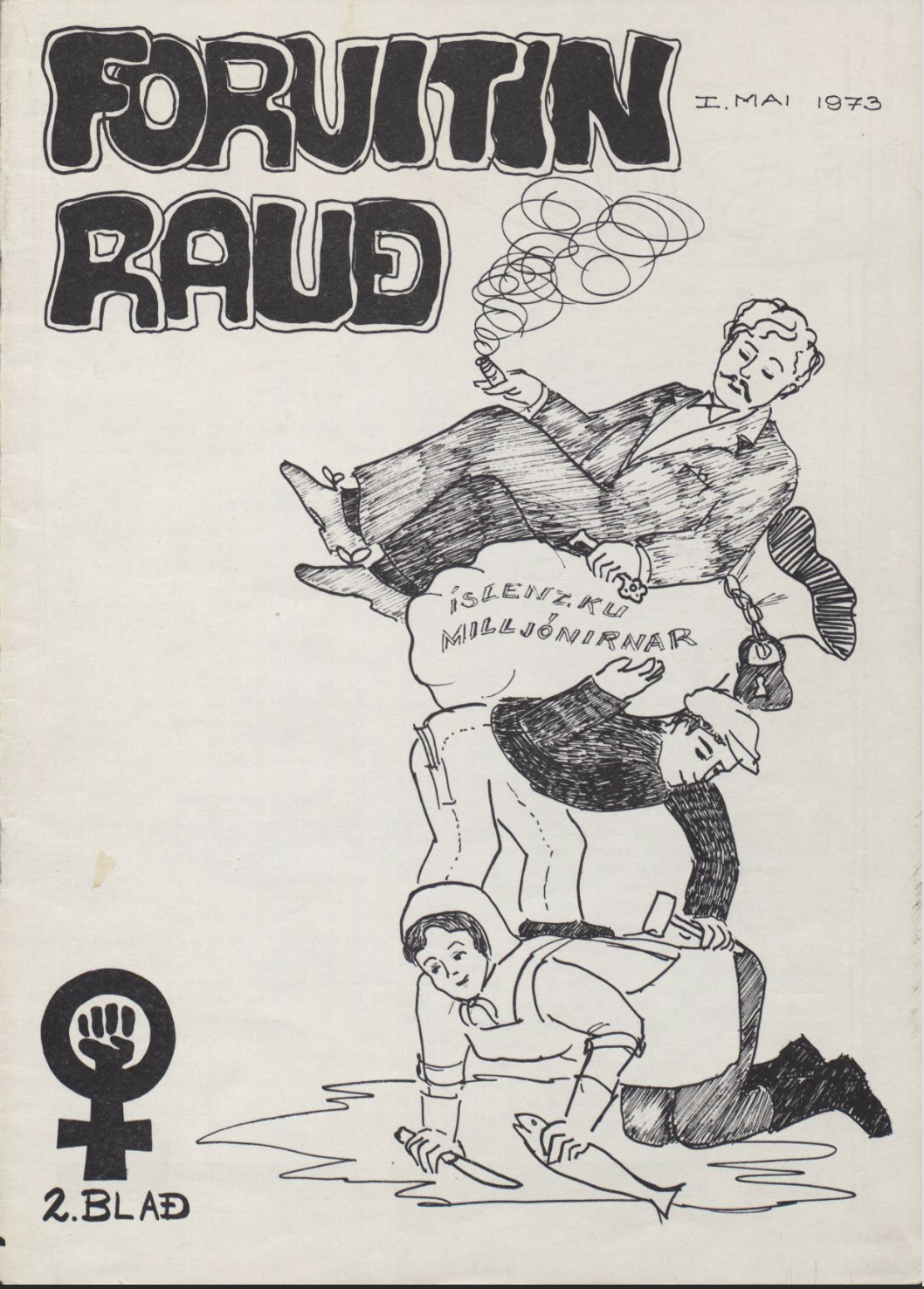
They chose to flip the script. In October 1975, the Redstockings and other women’s organizations came together to demonstrate that women’s circumstances were not derived from the laws of nature, but rather were burdensome and contingent. They accomplished this goal in a women’s “Day Off,” so named for two reasons: 1) strikes were illegal and 2) for housewives, it was lack of rest, not poor working conditions, that was the main issue of the day. Below is the original flyer for the demonstration, as well as a translation.
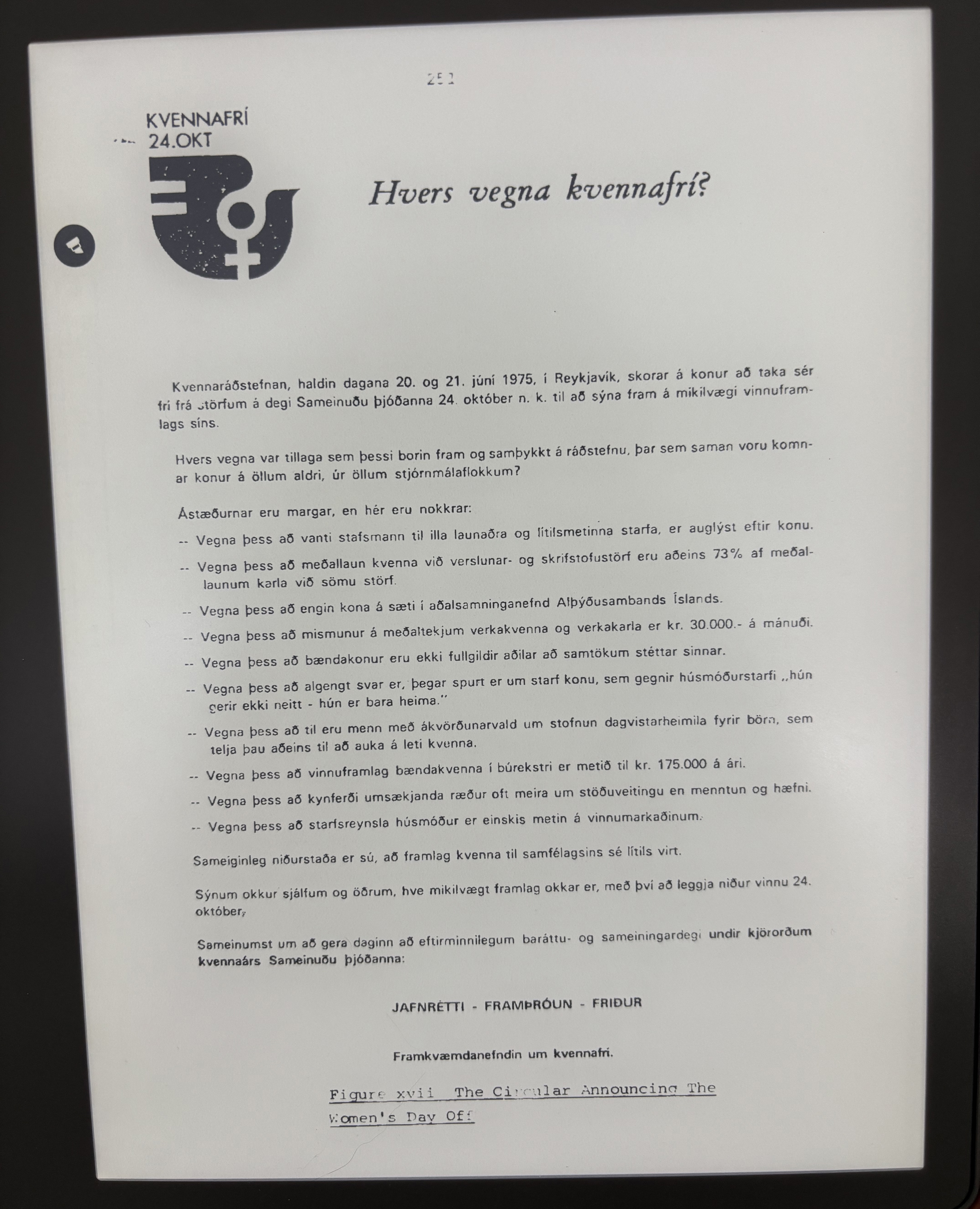
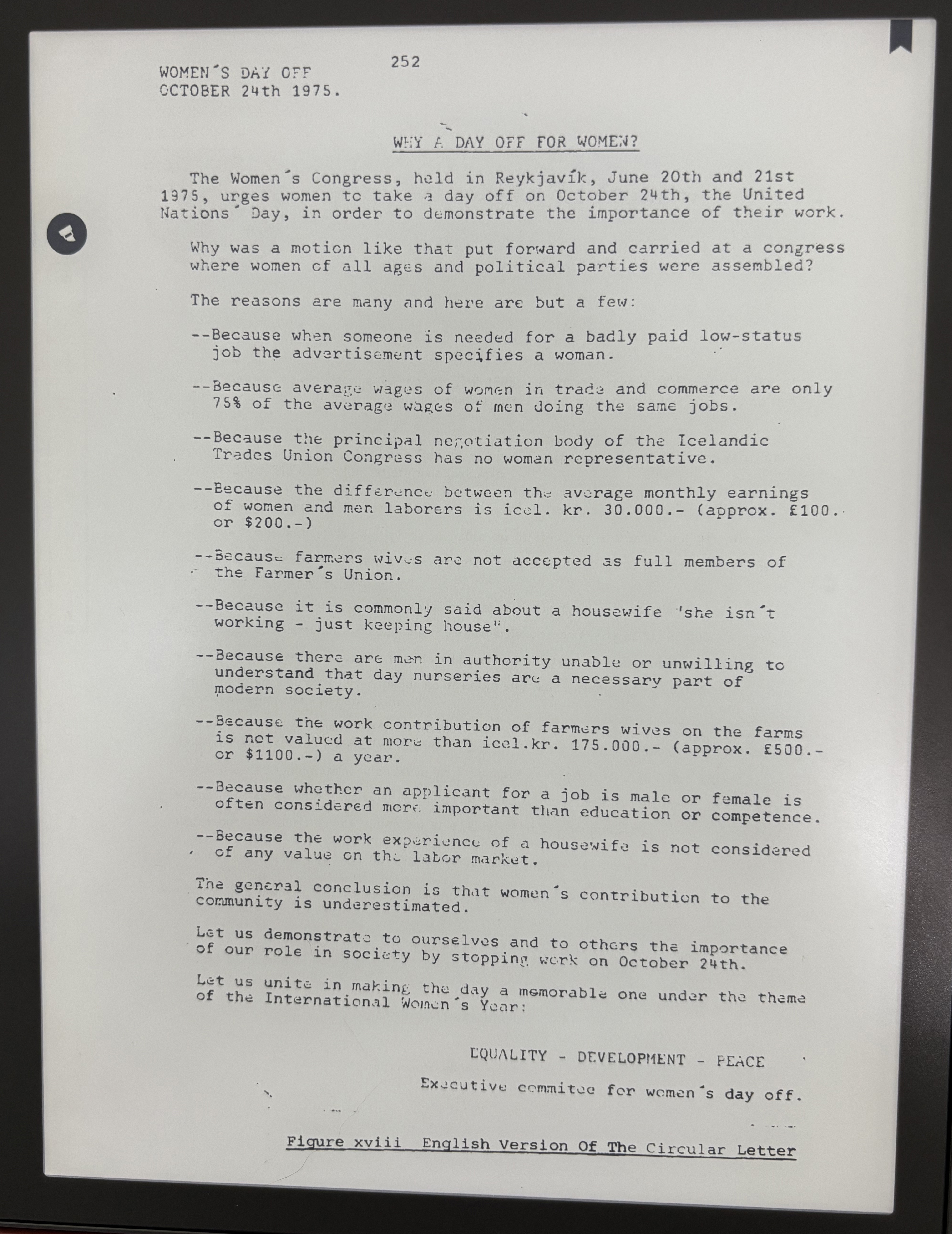
The organizers focused on economic inequality, including wage discrimination, the undervaluation of women’s work, and labor market discrimination. The flyer highlighted that a job applicant’s sex is placed above qualifications and competence in want ads and hiring decisions. The flyer also pointed to women’s lack of representation in political parties and trade unions. Writing from an American context, I find it particularly significant that housework was presented as unskilled, uncompensated labor. In 1975, coverture remained a state of mind—for the men, not the women. Nevertheless, the men held the political and financial power.
To rectify this imbalance, the women needed an action so revealing of truth that it could not be argued against. With 90% of Icelandic women taking a day off from work and children, men were denied agency that day—childcare is an unavoidable obligation, no matter anyone’s paid employment schedule. The point was made. According to anthropologist M. E. Johnson, in her 1984 dissertation Women in Iceland, men experienced for the first time the taxing nature of childcare and housework: “Many women talked rather gleefully of husbands, who had stayed at home or taken their children to work, looking exhausted at the end of the day.”14 The men had “a brief taste of having to combine waged work and domestic commitments.”15 Feeling the toll of the double burden, in other words, was believing. It forced men to embody the experiences of their most intimate partners–experiences seen but unobserved for years. At the end of a long women’s “Day Off,” the revelations from this flip of the script needed no articulation—they were inscribed onto Icelandic male faces and bodies.
How Liberian women moved beyond demonstrations to make spiritual war in Part II …
Joan C. Williams quoted in Ray Tyler, “A War among Women,” Teaching American History (blog), August 27, 2021, https://teachingamericanhistory.org/blog/a-war-among-women/. ↩
Customary and constitutional law in Liberia coexist as parallel legal systems. ↩
Leigh Gardner. “African American Migration to Liberia, 1820-1906.” Journal of Slavery and Data Preservation 5, no. 3 (2024): 22-31. https://doi.org/10.25971/0p5s-rx30; Johanna E. Bond, Women’s Legal Rights, in Oxford Research Encyclopedia of African History (2019), https://scholarlycommons.law.wlu.edu/fac_books/28]. ↩
E. H. Deering, “Coverture and Lasting Effects of Gender Inequality: An Analysis through Equal Protection Jurisprudence,” Washington University Jurisprudence Review (Vol. 16.2), 296. ↩
Ibid, 299-300. ↩
William Blackstone, Commentaries on the Laws of England, book 1, chap. 15, Lonang Institute, accessed January 22, 2026, https://lonang.com/library/reference/blackstone-commentaries-law-england/bla-115/. ↩
Encyclopædia Universalis, s.v. “Droit civil des personnes (France) : repères chronologiques,” accessed January 22, 2026, https://www.universalis.fr/encyclopedie/droit-civil-des-personnes-reperes-chronologiques/. ↩
Simone de Beauvoir, Le Deuxième Sexe (Paris: Gallimard, 1949), Introduction. ↩
Ministry for Foreign Affairs, Gender Equality in Iceland (Reykjavík: Government of Iceland, 2017), 3, https://www.government.is/media/utanrikisraduneyti-media/media/mannrettindi/Gender-Equality-in-Iceland.pdf. ↩
Margaret E. Johnson, "Women in Iceland" (PhD diss., University of Durham, 1984), 86-90. ↩
Reify is an academic term that should be integrated into popular vocabulary. It means “to consider or represent (something abstract) as a material or concrete thing.” Merriam-Webster.com Dictionary, Merriam-Webster, https://www.merriam-webster.com/dictionary/reify, accessed 28 Jan. 2026. ↩
M. E. Johnson, 120-134. ↩
Ibid. ↩
Ibid., 255. ↩
Ibid., 256. ↩